My throat tightened.
“Grandpa was wrong.”
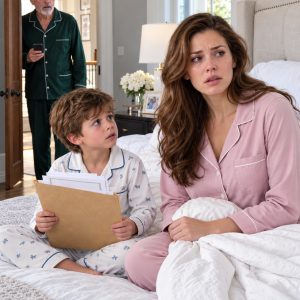
Oliver studied my face.
“Was spilling the juice really bad?”
“No, sweetheart.”
“It got on the shoes.”
“I know.”
“I didn’t mean to.”
“I know that too.”
Then came the question I had been dreading.
“Grandma said I was a mistake.”
There was no sentence powerful enough to erase what he had heard.
So I gave him the truth.
“You are not a mistake, Oliver. You have never been a mistake.”
He moved closer until his forehead rested against my arm.
I remained there until he fell asleep again.
PART 7: THE BOUNDARY I SHOULD HAVE SET YEARS EARLIER

When I reopened the laptop, Daniel was standing alone on the porch.
The police had finished their initial documentation.
He called me.
“The notice has been served. Your parents can respond through counsel, and any lease termination will proceed legally.”
I looked at Oliver.
“They cannot invite us back simply because they know I own the house.”
“Correct.”
“And I cannot force them to love my son.”
Daniel waited.
“Correct.”
I took a slow breath.
“Then I want distance established in writing.”
“I can prepare that.”
I also instructed Daniel to tell my father to hire independent counsel before signing anything Jonathan placed in front of him.
The purchase option remained part of the lease.
I had no interest in using ownership to trick anyone.
That distinction mattered.
The next morning, Madison sent a message.
She claimed she had not known I owned the property or that Jonathan’s financial plans extended beyond temporarily moving in.
Then she wrote:
I should have stopped them before you ever reached the door. I am sorry.
I did not answer.
Madison had smiled when my old bedroom became hers.
Not knowing who owned the house did not erase that choice.
My mother called twice.
I ignored both calls.
On the second attempt, she left a voicemail.
“Claire, I am not calling about the lease. I know I should ask about Oliver first. I hope he stayed warm. I hope he slept. What I said was cruel, and I am sorry. I understand if he never wants to see me again.”
I listened twice.
It was the first apology I could remember receiving from my mother that did not contain the word but.
I still did not call back.
My father eventually contacted an attorney.
His first message to me said:
I read the lease this time. I am sorry I did not read it properly before.
I wanted him to mention the door.
The snow.
Oliver crying.
Perhaps paperwork was easier for him than emotion.
I replied:
Oliver heard everything you said. Give us time.
Thomas responded:
I will.
PART 8: THE HOUSE WAS NEVER THE MOST IMPORTANT THING
December arrived quietly.
My parents remained in the Scarsdale house while the lease matter proceeded through the appropriate legal channels.
I paid the hotel bill, then rented a small furnished home closer to Oliver’s preschool.
For the first time in years, I stopped managing my parents’ practical lives.
I no longer fixed their websites.
I no longer handled confusing bills.
I no longer called repair companies on their behalf.
Daniel handled all property communications.
Madison separated from Jonathan while they untangled their financial situation.
She later told me she had found a paper crown Oliver made at preschool sitting inside a box in my old bedroom.
She returned it exactly where she found it.
My mother asked permission to send Oliver a Christmas present.
I said no.
A week later, she mailed me an unsealed letter addressed to him.
She wrote carefully that adults sometimes say terrible things while angry, but what she said was untrue.
He had done nothing wrong by spilling juice.
He was not responsible for anyone’s anger.
She was sorry she frightened him.
I placed the letter in a drawer.
Oliver was four.
I would read it when I believed it could help him, not when my mother needed forgiveness.
That distinction became important to me.
Missing my parents did not mean we were ready to return.
Owning the house did not mean I needed to remove them immediately.
Accepting an apology did not require restoring access to my son.
Boundaries were not revenge.
They were simply the structure required after trust collapsed.
A few days before Christmas, snow covered the neighborhood playground near our rental.
Oliver asked whether we could stop.
I said yes.
He ran toward the smallest slide, his winter boots leaving uneven marks across the white ground.
He climbed slowly because his gloves kept slipping against the railing.
At the top, he turned around.
He needed to know I was still there.
I raised one hand.
“I’m watching.”
Oliver smiled.
Then he pushed himself down the slide and landed laughing in the snow.
For several seconds, I simply watched him.
The house in Scarsdale was still mine.
My parents were still inside it.
Lawyers were still exchanging documents.
Jonathan still had explanations to give.
Madison still had choices to examine.
My mother still had apologies she needed to prove through behavior rather than words.
None of those things felt urgent anymore.
Oliver climbed the slide again.
“Look at me, Mom!”
“I’m looking.”
He reached the top and turned back once more.
This time, he did not look frightened.
He only wanted to know I was watching.
I was.
That was what mattered.
Four years earlier, I purchased my parents’ house because I thought preserving a place might preserve a family.
Thanksgiving taught me something different.
A house can shelter people without making them safe.
A lease can protect access without creating affection.
Money can prevent foreclosure without repairing contempt.
The most important thing I owned was not the property my parents had lost.
It was the ability to decide where my son would be treated with kindness.
I had spent years solving problems for people who treated my competence like an embarrassment and my generosity like an entitlement.
I thought silence kept the peace.
In reality, silence only made it easier for everyone else to pretend nothing needed to change.
That night, my father locked us outside.
For the first time, I stopped reopening the door for everyone.
I did not need to make them homeless.
I did not need to humiliate them publicly.
I did not even need them to understand me immediately.
I only needed to stop allowing their discomfort to become my responsibility.
Oliver slid down again, laughing when snow sprayed around his boots.
Then he ran toward me.
I crouched and opened my arms.
He crashed into them with the absolute confidence of a child who knew someone would catch him.
For years, I had quietly protected my parents’ home.
From that winter forward, I understood that protecting my son’s sense of safety mattered infinitely more.
And for the first time in a very long while, that decision felt simple.
THE END