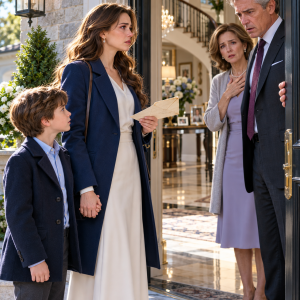
“I copied your signature from scanned documents.”
The room went silent.
He admitted using old signature images on the guaranty, gift acknowledgment, and vendor paperwork.
“I kept telling myself nothing would ever hurt you.”
I stared at him.
“You guaranteed almost half a million dollars under my identity.”
“The company was doing well then.”
“You erased the debt you owed me.”
“I thought I could repay you later.”
“You knew what you were doing.”
Grant closed his eyes.
“Yes.”
Then I asked why.
His answer was ugly enough to sound true.
Every time he looked at the business, some part of him remembered that he had needed me to start it.
When investors asked about my loan, he felt fraudulent.
So he removed me from the story.
“You hated needing me.”
“Yes.”
I thought about the first slap, the flowers afterward, the second shove, the broken wall, the wrist, the locked door.
Grant had not become dangerous in one morning.
“You became this person one permission at a time.”
He looked confused.
I explained.
The first time he hurt me and I stayed, he learned staying was possible.
Judith excused him, so excuses became available.
Then he touched my money, my identity, and my property.
Each time nothing immediately stopped him, he took something more.
Grant began crying.
I felt compassion.
That frightened me until I understood compassion did not require surrender.
“I did love you,” he whispered.
“I believe you.”
Hope appeared.
I ended it immediately.
“That is part of what makes this so painful. I am still not coming back.”
The mediation lasted seven hours.
Grant eventually acknowledged in writing that the house was my separate property and withdrew any ownership claim beyond narrow reimbursement issues.
He also agreed that the disputed gift document would not be used in the divorce.
When I left, I sat inside my car and cried for twenty minutes.
Leaving someone you fear can still mean grieving someone you once loved.
Both truths can exist.
PART 6: CONSEQUENCES WITHOUT A MOVIE ENDING
Nearly a year passed before the criminal matters resolved.
The domestic-violence investigation included medical records, photographs, earlier messages, security logs, and hallway footage showing me leaving with a bleeding wrist.
Judith acknowledged seeing Grant grab me, although she minimized it.
The financial case was stronger.
Copied signatures.
Metadata.
Grant’s handwritten notes.
Lender files.
Accounting records.
Emails.
Grant eventually entered a negotiated plea accepting responsibility for assault and a financial offense connected to the forged guaranty.
His sentence included supervised probation, mandatory intervention counseling, restitution, restrictions on contacting me, and a short period of custody.
Some friends believed the sentence was too light.
Maybe it was.
But I eventually understood that I did not need Grant’s life permanently destroyed to prove mine mattered.
He lost control of the company, access to my home, significant money, many client relationships, and much of his professional reputation.
The company restructured.
The minority investor increased ownership.
Grant retained a smaller economic interest but no management authority.
Twenty-four of the original twenty-eight employees remained.
Maria returned as chief accountant.
The business changed its name two years later.
My financial settlement recovered most of what could still be traced from the original loans.
Not every dollar returned.
Eventually, my lawyer asked whether I wanted to spend thousands more chasing the final disputed amount.
I laughed.
“No.”
Winning was no longer synonymous with recovering every possible dollar.
Sometimes winning meant knowing when the remaining fight cost more than it returned.
Our divorce became final sixteen months after I left.
The hearing took less than thirty minutes.
Afterward, I went downstairs, made coffee, and sat in my kitchen.
My kitchen.
My house.
I had repainted the bedroom, replaced the robe Judith had worn, changed the locks, and replaced the damaged heavy office door with frosted glass.
I no longer wanted to live behind barriers.
Judith later sent a letter apologizing without demanding a response.
Grant sent another through his court-approved counseling program.
He wrote:
“I used to believe control was the same thing as safety. When I felt ashamed, I controlled money. When I felt afraid, I controlled you. I am learning that becoming different is something other people should notice over time, not something I get to announce.”
I kept the letter.
I did not reopen the relationship.
PART 7: 4:40, TEN YEARS LATER

Two years after the divorce, I replaced the burgundy evidence folder with a green one containing the deed, my updated will, investment statements, and a business plan.
Before Grant’s company consumed our marriage, I had worked in procurement and compliance systems.
I returned to that work.
A former colleague asked me to consult on vendor controls.
One project became three.
Eventually I created ClearLine Operations, a small consulting company specializing in procurement audits, vendor controls, process mapping, and internal compliance.
Three years later, ClearLine employed nine people.
Later, it reached fifteen, and I deliberately stopped expanding because I had finally learned that “enough” was a legitimate business strategy.
Years later, I married Ben Carter.
We purchased a small weekend property together, while the house inherited from Aunt Margaret remained mine.
Ben read our prenuptial agreement carefully.
Then he signed it without complaint.
Paperwork did not make marriage less romantic.
It removed dangerous assumptions.
Ten years after the morning I left Grant, I woke before sunrise.
The clock read 4:37.
For several seconds, I remembered the blanket being pulled away, Grant’s hand, Judith in my robe, and blood moving down my wrist.
Then I walked into the kitchen.
I found oatmeal in the cabinet.
I started laughing.
Ben appeared in the doorway.
“What are you doing?”
“Making oatmeal.”
He glanced at the clock.
“At four forty in the morning?”
“Apparently.”
“Want company?”
I considered it.
“Yes.”
Ben sat at the table.
He did not tell me how much sugar to use.
He did not demand coffee.
He expected nothing.
I made two bowls because I wanted to.
That difference contained an entire lifetime.
Later that morning, I opened the red notebook Ben had given me on our wedding day.
On the first page he had written:
FOR THE THINGS YOU CHOOSE TO REMEMBER.
Over the years, I filled it with ordinary things.
ClearLine’s first profitable quarter.
Hydrangeas blooming beside the porch.
Vacations when I stopped checking security cameras.
Maria becoming a friend.
Ben’s daughter graduating.
The day I accidentally encountered Grant in a grocery store and realized fear could appear in my body without controlling my decisions.
Near the back, I found a blank page.
I wrote:
4:40 a.m. — oatmeal because I wanted it.
Then I closed the notebook.
For years, I believed the burgundy folder saved me.
It did not.
The documents helped.
The alarm helped.
Melissa helped.
Rebecca helped.
Maria helped.
The courts helped.
But the first thing that saved me was smaller than all of them.
At 4:40 one morning, after years of fear, my husband gave me an order.
And I finally understood that I did not have to obey.
THE END