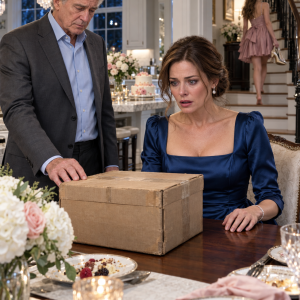
I had struggled emotionally.
Perhaps I had become confused about important possessions.
Rebecca stood.
“The opposing side is attempting to convert documented conduct into a dispute about temperament. We have records showing unauthorized financial activity, private files concerning Ms. Cole’s inherited property, communications drafted under her identity, surveillance material concerning two women, and payments to a third party now under investigation. That is not merely marital resentment.”
When I testified, Grant’s attorney eventually asked about my grief.
“Mrs. Cole, you misplaced important possessions after your mother’s death, correct?”
“Yes.”
“Including the letters later located in the storage unit?”
“I believed I had misplaced them.”
“Is it possible you stored them there yourself and simply forgot?”
Grant watched me carefully.
He was waiting for emotion to become evidence.
I leaned toward the microphone.
“Grief made me forget appointments, lose my keys, and cry because I saw my mother’s favorite coffee in a supermarket. It did not make me rent a storage unit controlled by my husband, prepare false communications under my own name, photograph my security system, and file my mother’s letters beneath a folder analyzing how my grief might make me easier to discredit.”
The courtroom became completely still.
“My grief made me vulnerable. It did not make me responsible for his choices.”
The judge maintained financial restrictions and granted protective conditions preventing Grant from entering the townhouse or contacting me indirectly.
Outside the courtroom, he tried to approach.
“Laura, you think you won.”
Once, his expression could determine the emotional weather of my entire day.
Now I simply looked at him.
“No. I think I finally stopped volunteering to lose.”
Part 7 – The Woman He Expected Me to Hate
Vanessa waited near the courthouse steps.
Her company had offered her a transfer to Denver, and she had decided to accept.
Before leaving, she wanted to apologize once without asking Grant’s lies to erase her own choices.
“Even believing his story, I knew bringing me into your house that night was cruel. I wanted to feel chosen badly enough that I called cruelty courage.”
That was more accountability than Grant had offered.
“Thank you for saying that.”
“Do you forgive me?”
I considered the question.
“Not completely, and not today. But I no longer want anything bad to happen to you.”
She nodded.
There was relief in being given an answer that was neither punishment nor false absolution.
“I can live with that.”
Grant had written us into competition because rivalry prevented comparison. Once Vanessa and I compared what he had told each of us, his stories became much harder to maintain.
We were never friends.
We did not need to become friends to stop functioning as enemies.
Part 8 – The Dinner I No Longer Waited Through

The divorce became final four months later.
The criminal investigation continued longer.
Owen Caldwell supplied another set of internal records. Emily Carson, Grant’s twenty-three-year-old assistant, testified that he pressured her to backdate authorizations and threatened her job when she hesitated. Victor Hale cooperated enough to establish what Grant had hired him to do.
Eventually, Grant accepted a plea agreement involving the financial misconduct supported by the evidence.
His sentencing occurred during the first snowfall of winter.
I attended because I needed to hear the end without imagining it later.
Grant apologized to clients, colleagues, and the firm.
He never said my name.
For a moment, that omission hurt.
Then it gave me something his apologies never could have provided.
Clarity.
Some people never give you the exact acknowledgment you deserve. Waiting for them to produce it becomes another way of allowing them to control when your life can continue.
That evening, I returned to Society Hill.
I had considered selling the townhouse twice, but ultimately realized Grant had not ruined the house. He had merely misunderstood what it represented.
To him, it had been leverage.
To my mother, it had been proof that a woman could rebuild.
I set the dining table and prepared rosemary chicken using the same recipe from our anniversary, although I changed enough ingredients that it no longer tasted exactly like memory.
One candle stood in the center.
At seven, the doorbell rang.
Rebecca stood outside holding dessert. Ethan carried flowers, and behind them stood Emily Carson, looking nervous while clutching a bottle of sparkling cider.
“You were not planning to eat the anniversary dinner alone, were you?” Rebecca asked.
“It is not an anniversary dinner anymore.”
Ethan smiled.
“Then what are we celebrating?”
I looked past them at the softly falling snow.
“The night I stopped waiting.”
We ate around the same table where Grant once arrived with Vanessa believing he was introducing me to my replacement.
Conversation began cautiously before becoming warm. Emily told us about her new job at a nonprofit accounting office where nobody had yet requested forged documents, which she considered an encouraging professional standard.
Later, after everyone left, I opened the silver frame containing the honeymoon photograph Grant and I had taken in Maine.
I did not hate the woman smiling inside it.
I did not hate the man beside her either.
What we had once felt could have been real even though what came later became destructive. My love did not become foolish merely because Grant eventually proved unworthy of receiving it.
I removed the photograph.
The damaged silver frame stayed.
The picture went into a box containing things that belonged to my history without controlling my future.
Then I walked downstairs and extinguished the candle.
For years, being alone had sounded like abandonment.
That night, being alone meant nobody else was writing documents in my name, measuring my grief for leverage, or deciding how much of myself I needed to surrender to remain loved.
The townhouse settled quietly around me.
My mother had built a life there after somebody else left.
Now I understood why she never called that survival a tragedy.
Grant had brought another woman through my door believing she would replace me.
Instead, he introduced me to the woman I had become while preparing for his departure.
She no longer needed to be chosen.
She had finally chosen herself.
THE END