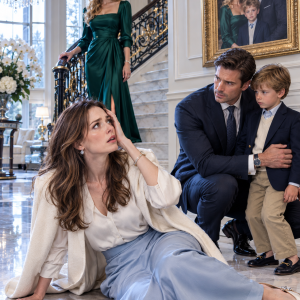
“I needed you to be my husband.”
I paused.
“The company can hire another CEO.”
That was the sentence that finally hurt him.
Not the affair.
Not the trust.
Not losing the house.
Jonathan had built his identity around believing he was irreplaceable.
The board had proven otherwise in less than an hour.
4. The Divorce Audit
I am a numbers person by nature, so once the immediate crisis passed, I began examining my marriage the way I would examine a complicated financial statement.
Patterns appear differently when placed in chronological order.
During our second year, Jonathan began referring to Carter Meridian as his company in interviews.
During our third, he pressured me to reduce my involvement because investors supposedly preferred “one clear executive voice.”
During our fourth, he began excluding William from meetings unless legally required.
During our fifth, he complained that my trust structure prevented him from making fast decisions.
During our seventh, he began asking whether I had considered changing incapacity provisions.
By the eighth, he was carrying paperwork into a hospital room while I prepared for emergency surgery.
The affair was devastating.
The attempted financial control was worse.
My divorce attorney, Allison Reed, reviewed the evidence and said something I never forgot.
“Infidelity explains why a marriage ends emotionally. Documents often explain why it became unsafe structurally.”
Jonathan had not simply fallen in love with someone else.
He had begun planning a future in which he retained access to the property, business authority, and prestige he associated with marriage to me.
The betrayal had a balance sheet.
Two weeks after the board meeting, Jonathan returned to the Atherton house under attorney supervision to collect the rest of his belongings.
The wedding portrait was gone.
I had placed it in the same cardboard box he used for my photographs and my father’s urn.
Jonathan noticed immediately.
“You took it down quickly.”
“You packed my entire life in one afternoon.”
He carried two suitcases upstairs and returned forty minutes later.
Before leaving, he looked toward Grace sleeping in the bassinet.
“I want to see my daughter.”
“Then build a relationship with her that is not dependent on controlling me.”
“I am her father.”
“Then behave like one.”
He held the house key for several seconds.
“I really believed this was my home.”
For the first time, I answered without anger.
“It was your home because I trusted you enough to share it.”
I looked at the key.
“That was never the same thing as ownership.”
He placed it on the entry table.
Then he left with the same two suitcases he had once prepared for me.
5. What Ownership Actually Means

The divorce became final months later.
The Atherton residence remained within the Carter family structure.
The trust assets remained protected.
Jonathan received the property and compensation to which he was legitimately entitled under our agreements, but nothing created ownership simply because he had spent years behaving as though it existed.
A new chief executive took over Carter Meridian.
I became more active as chairwoman.
I still disliked interviews.
I still had no interest in becoming the public face of everything my family owned.
What changed was my willingness to disappear so somebody else could feel important.
For years, I allowed Jonathan to say “my company.”
I allowed him to describe family assets as though I were a passive beneficiary.
I thought correcting him would seem petty.
I thought a strong marriage meant not competing over credit.
What I failed to understand was that repeatedly surrendering language can eventually surrender reality inside a relationship.
Jonathan did not wake up one morning believing the company belonged to him.
I helped create that illusion every time I stayed silent when he claimed ownership of something that had only been entrusted to his management.
That realization was uncomfortable.
It was also useful.
Grace was almost six months old when I finally unpacked the cardboard box Jonathan had prepared for me.
I cleaned my father’s urn and returned it to the library.
I framed several photographs.
I stored the wedding portrait rather than destroying it because eight years of my life did not need to be erased simply because the ending was painful.
At the bottom of the box, I found Jonathan’s old house key.
I carried it into the living room.
The wall where the wedding portrait once hung remained empty.
For weeks, that empty space looked like loss.
That afternoon, it looked like possibility.
Grace woke and reached toward me from her blanket.
I picked her up.
Her fingers wrapped around mine.
I remembered Jonathan standing in that room three days after her birth, telling me to take the baby and leave his house.
The arrogance of the sentence seemed almost unbelievable now.
A key can open a door.
A title can authorize someone to run a company.
A marriage can give somebody access to a life that existed before them.
None of those things automatically create ownership.
Not of a home.
Not of a company.
And certainly not of another person.
Months later, I spoke at a small internal leadership meeting for Carter Meridian.
One young executive asked how I had known it was time to remove Jonathan.
I thought about the obvious answers.
The affair.
The suitcases.
The hospital documents.
Instead, I said:
“I knew when I realized he thought my survival was a governance problem and my absence was a business opportunity.”
Nobody spoke for several seconds.
Then I added:
“A good executive understands stewardship. A dangerous one eventually mistakes stewardship for possession.”
That principle applied far beyond corporations.
It applied to marriages too.
Jonathan had believed he possessed the company because he ran it.
He believed he possessed the house because he lived there.
He believed he possessed my choices because I had spent years accommodating his.
When I stopped doing that, almost everything he called his disappeared at once.
Not because I stole it.
Because it had never belonged to him.
On Grace’s first birthday, I carried her onto the terrace behind the house.
Morning sunlight moved through the redwood trees beyond the garden.
The scar from the cesarean section had faded into a pale line.
I still noticed it sometimes.
Not because it reminded me of pain.
Because it reminded me that the same body Jonathan once described as too weak to make decisions had carried me through the hardest year of my life.
Grace pressed both hands against my cheeks.
“Mama,” she said, still uncertain whether the word referred specifically to me or every woman she liked.
I laughed and kissed her forehead.
Inside, the house was full of friends, family, balloons, and a birthday cake large enough to feed people for three days.
No one had asked Jonathan’s permission to be there.
No one needed it.
I looked through the open doors toward the living room.
A new photograph now occupied the wall where our wedding portrait had hung.
It showed Grace and me sitting beneath the redwoods six months after the divorce began.
No corporation.
No trust documents.
No jewelry.
No evidence of wealth.
Just a mother holding her daughter.
That picture represented more ownership than the property deed ever could.
The deed proved where I was legally allowed to remain.
The trust proved what assets I controlled.
The board resolutions proved what authority could be withdrawn.
But Grace had taught me something no document could establish.
A home is not the place somebody allows you to occupy.
It is the place where neither you nor your child has to earn the right to stay.
I held her closer.
“We are home, sweetheart.”
This time, there was nobody standing nearby pretending the word belonged to him.
THE END