“That is how he controlled all of us,” Eleanor said. “He never threatened only the person standing in front of him.”
Twenty-five minutes later, Charles entered the bank with an attorney, a notary, and two private security officers.
He still dressed impeccably at seventy.
His composure lasted until he saw Thomas.
“This man has been harassing me for money for years.”
Thomas stepped forward.
“Look at me and say I am not your son.”
Charles looked instead toward the safe-deposit documents.
“Those files contain confidential corporate material.”
Diane immediately intervened.
“The box is registered solely to Eleanor Whitaker. You have no authority over its contents.”
Charles’s attorney opened another folder.
“We filed an emergency petition this morning requesting temporary financial guardianship over Mrs. Whitaker due to concerns regarding diminished capacity.”
Eleanor felt cold.
The attorney continued.
“Her recent hospitalization for serious cardiac disease, limited income, and sudden involvement with individuals seeking access to substantial assets raise legitimate questions about undue influence.”
Charles had taken her illness and turned it into another mechanism of control.
“You let me struggle for five years,” Eleanor said. “Now you want to use the condition that poverty helped worsen as proof that I cannot manage my own money?”
Charles’s voice rose.
“I am protecting what should eventually belong to our children.”
“You mean you are protecting yourself.”
Thomas removed a digital recorder from his briefcase.
Charles’s expression changed immediately.
The night before, Charles had met Thomas secretly at a Scottsdale hotel.
He offered five million dollars in exchange for a permanent confidentiality agreement and a waiver of future paternity-related claims.
Then the recording played.
Charles’s voice filled the room.
“Eleanor will never use that card. She would rather suffer than accept anything she thinks came from me. Once the five-year restriction expires, we petition for incapacity, move the trust back under family control, and complete the merger before anybody traces the original capital.”
Allison covered her mouth.
The recording continued.
“Once the merger closes, the old ownership structure disappears into the new holding company. Nobody will care where the first money came from forty years ago.”
Charles moved toward the recorder.
Michael stepped between them.
“Do not touch anything belonging to Mom again.”
For the first time, Charles lost his polished restraint.
“Everything I did was to preserve this family!”
Allison stared at him.
“Did preserving the family require pretending Thomas did not exist?”
Nobody answered.
Thomas then produced one final document.
Whitaker Industrial Holdings was scheduled to complete a major private-equity merger at nine o’clock the following morning.
A contractual clause allowed the transaction to be suspended if disputed or fraudulently obtained founding assets were identified before closing.
The original money came from Eleanor’s inheritance.
If a court accepted the evidence, the merger could be frozen.
Charles looked at Eleanor.
For five years, he had treated her as a discarded former wife surviving above a tire shop.
Now she held the one piece of evidence capable of stopping the largest transaction of his career.
3. Before Nine O’Clock

At 6:30 the following morning, Eleanor entered the headquarters of Whitaker Industrial Holdings in Scottsdale accompanied by Allison, Michael, Thomas, Diane, and commercial litigation attorney Rachel Sterling.
Eleanor wore a simple navy dress and the same inexpensive black shoes she had used while cleaning houses.
Thomas stayed several steps behind.
She turned toward him.
“Your mother tried to tell me the truth when doing so could have cost her everything. You are not walking into that building like an embarrassment.”
He hesitated.
Eleanor extended her hand.
“Walk beside us.”
Their attorneys had spent most of the night preparing an emergency filing based on the inheritance records, forged transfers, financial documents, and Charles’s recorded statements.
At 8:34, court officers entered the boardroom.
The merger was formally stayed twenty-six minutes before closing.
A court-appointed special monitor was authorized to preserve corporate records and prevent the transfer or destruction of disputed assets until ownership could be determined.
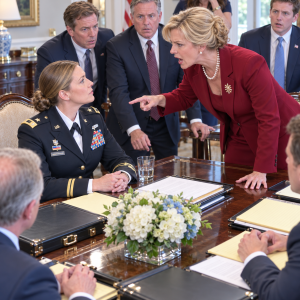
Charles sat at the head of the conference table beside executives from the acquiring firm.
“This woman has advanced cardiac disease and is being manipulated by people who see an opportunity,” he told them.
Eleanor placed Aunt Margaret’s original deed and sale statement on the table.
“For decades, this company has told employees, investors, and newspapers that Charles Whitaker built everything from nothing.”
She looked around the room.
“The first dollar came from property inherited by me, sold without an honest accounting to me, and converted into company ownership using documents carrying signatures I never made.”
Nobody interrupted.
An independent forensic review began that week.
Investigators eventually calculated that business interests directly traceable to Eleanor’s misappropriated inheritance had generated assets exceeding ninety million dollars.
The review also uncovered tax irregularities, falsified internal records, concealed payments to Linda Carver, and repeated efforts to obscure beneficial ownership.
Charles requested a private meeting.
Eleanor refused.
“Anything you need to say can be said in front of our children, Thomas, and counsel.”
For the first time in decades, Charles could not control the room.
He admitted taking Eleanor’s inheritance when his original repair business was close to collapse. He convinced himself he would repay her after the company became profitable.
When success arrived, repayment became more dangerous.
Every year of silence made the original theft harder to confess.
Michael leaned forward.
“Then why divorce Mom after thirty-seven years?”
Charles looked toward the window.
“Linda had cancer. She told me she intended to reveal Thomas and the original investment records before she died. If your mother remained my wife when the disclosures began, the financial review during any litigation could have exposed everything.”
Eleanor finally understood.
The divorce itself had been another concealment strategy.
The debit card was not generosity.
The hidden trust was Charles’s attempt to place enough money in Eleanor’s name to later argue that he had compensated her without admitting what he had done.
“Did you ever consider simply telling me the truth?” she asked.
Charles remained silent for a long time.
“I did not know how.”
Eleanor shook her head.
“You knew how. You simply never found a version that protected you enough.”
Thomas asked for only two things.
Charles had to legally acknowledge him as his son.
Linda Carver’s role as the company’s early bookkeeper, and the circumstances surrounding the concealed payments to her, had to be included in the corrected corporate history.
“I am not here to take Allison’s or Michael’s inheritance,” Thomas said. “I am here because I am forty-eight years old and tired of being treated like evidence somebody misplaced.”
Allison crossed the room and embraced him.
Charles signed the legal acknowledgment that afternoon.
He resigned as chairman shortly afterward and surrendered control over disputed assets while federal tax and financial investigations proceeded.
There was no dramatic reconciliation.