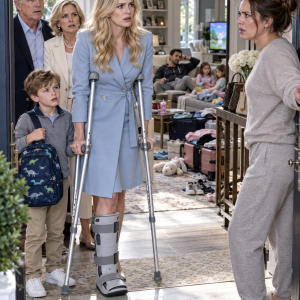
She understood that my parents would protect the expected first grandchild at any cost.
“Those records are fabricated,” Paige shouted. “Lauren created them because she hates me.”
Grandfather struck his cane against the deck.
“Then allow a medical professional to confirm the pregnancy.”
Paige looked toward the exits blocked by agents, then toward Connor standing in handcuffs.
Her hands slowly left her abdomen.
The silicone form shifted beneath the fabric, pulling the dress unevenly toward one side.
My mother made a broken sound.
“Paige, tell me that is not true.”
For the first time, the favored daughter had no prepared answer.
She attempted to remove the prosthetic beneath her dress, but dozens of witnesses had already seen the movement.
Paige looked toward me with open hatred.
“You took everything from me.”
“I stopped allowing you to take everything from me.”
The Family Defense That Finally Failed
My mother turned toward me.
“You could have paid the loan and prevented this humiliation.”
“You created this when you decided my identity, credit, vehicle, and career were available to preserve Paige’s image.”
My father lowered his voice, attempting to recover authority.
“We can still resolve this within the family.”
“You said that after stealing my vehicle. You said it after using my Social Security number. You said it while trying to declare Grandfather incompetent so you could take his assets.”
I looked at both parents.
“In this family, privacy always meant I should accept the damage while Paige avoided consequences.”
Agents escorted Connor from the yacht first.
My parents followed. My mother finally cried, but her attention remained fixed on guests recording her arrest.
My father searched the crowd for influential friends. Every person he approached stepped away.
The reputation they protected by sacrificing others collapsed within minutes because it had never rested on integrity.
Paige remained seated among broken glass and spilled champagne until a female agent instructed her to stand.
The perfect baby shower, designed to confirm her position within the family, became the setting where every lie surfaced at once.
The Consequences Nobody Could Pay Away
The investigation continued for months.
The bank canceled the fraudulent credit line and corrected my credit history. The motor vehicle agency restored the Range Rover registration to my name.
My appraisal license remained intact after investigators notified the state board that my identity had been used without consent.
Connor pleaded guilty to bank fraud, wire fraud, falsification of lending records, and money laundering. Auditors discovered additional loans involving fictitious borrowers and relatives of clients. He received a lengthy federal sentence.
Paige cooperated with prosecutors after Connor implicated her in the shell companies. Her assistance reduced her sentence, although it did not eliminate responsibility for conspiracy, identity theft, false sworn statements, and elder financial exploitation.
She lost the Manhattan apartment, luxury property purchased with borrowed funds, and most of the social circle she treated as permanent.
My parents sold their Rye residence to cover legal fees, restitution, and penalties. They were removed from charitable boards and private clubs that once defined their social world.
The court permanently prohibited them from managing Grandfather’s trust or acting as his financial representatives.
My father wrote several letters accusing me of destroying the family name.
He never acknowledged that he had been willing to destroy his daughter’s credit and professional future to preserve that name.
My mother wrote only once.
She claimed motherhood required protecting the child who needed the most help.
I did not answer.
Paige had never needed the most help. She had simply learned that creating emergencies guaranteed rewards.
The Trust My Grandfather Asked Me to Protect

One year after the yacht operation, I left the federal courthouse in Manhattan after the final restitution proceedings.
Grandfather waited beside the restored Range Rover.
He had appointed me sole trustee of the Hart Family Trust.
“I did not select you because you are my granddaughter,” he said. “I selected you because you protected the trust even when the threat came from people carrying our name.”
Together, we established a charitable foundation supporting elderly people facing abusive guardianship petitions and individuals whose identities had been exploited by relatives.
My professional firm promoted me to vice president of special valuations. The new role involved disputed estates, distressed property portfolios, fraud investigations, and assets hidden during family litigation.
The work suited me because valuation had always concerned more than calculating price. It required examining ownership, restrictions, risk, and the difference between appearance and documented reality.
Grandfather held out the vehicle key.
“Do you still like this car?”
“I do, although it means something different now.”
“What does it mean?”
I looked at the reflections of Manhattan buildings across the dark paint.
For years, I believed independence meant never asking anyone for help. My family encouraged that belief because self-sufficient people were easier to neglect.
Now I understood that independence also meant refusing responsibility for debts, lies, and sacrifices that belonged to other adults.
“Recovering something does not always return you to where you began,” I said. “Sometimes it proves nobody can remove it without consequences again.”
Grandfather smiled and placed the key in my hand.
The Life Beyond the Perfect Family
I never recovered the family my parents displayed in holiday photographs.
That family had never existed beyond carefully arranged clothing, expensive homes, and an agreement that Paige’s comfort mattered more than everyone else’s boundaries.
What I gained was less impressive in photographs and considerably more valuable.
I gained a career based upon documented competence rather than family approval. I gained control over my financial identity. I gained a relationship with Grandfather no longer mediated through people who resented his trust in me.
Most importantly, I learned that setting a boundary does not destroy a healthy family.
It reveals whether health existed before the boundary appeared.
Two years after the investigation, I evaluated an industrial portfolio for a widowed client whose son had attempted to transfer properties using an expired power of attorney.
During our final meeting, she asked why I had noticed the authorization problem so quickly.
I considered giving a technical explanation concerning execution dates, revocation notices, and title-chain inconsistencies.
Instead, I answered honestly.
“I have seen what happens when relatives treat legal access as ownership.”
She nodded as though she understood more than I had said.
That evening, I drove home through the city while rain touched the windshield.
The Range Rover no longer represented Grandfather choosing me over Paige. I did not need another comparison to establish my worth.
It represented evidence that generosity does not erase ownership, family does not cancel consent, and love does not require surrendering the documents that protect your life.
The question Grandfather asked when I arrived by rideshare had seemed to concern a missing vehicle.
In reality, it exposed the first visible piece of a system built around stealing from the person least likely to cause trouble.
My parents believed silence made me manageable.
Paige believed favoritism made her untouchable.
Connor believed professional access allowed him to convert my identity into collateral.
They misunderstood all three things.
Silence can end.
Favoritism cannot defeat evidence.
Access is not ownership.
When the truth finally reached the yacht, I did not destroy my family.
I stopped protecting the people who had already destroyed every honest part of it.
THE END