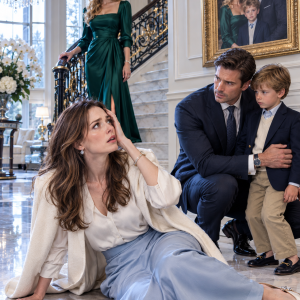
Malcolm noticed our exchange, and relief flashed across his face.
Before he could recover completely, the ballroom doors opened.
Two uniformed officers entered with Detective Nora Delgado, a fifty-eight-year-old investigator whose gray hair, broad shoulders, and unimpressed expression made wealth appear embarrassingly temporary.
She stopped before Malcolm.
“Mr. Ashford, we need to speak with you regarding the disappearance of Celeste Monroe.”
The ballroom erupted in questions.
“I have no information about her disappearance,” Malcolm replied.
“When did you last see her?”
“Several weeks ago.”
Detective Delgado glanced toward the frozen hotel invoice.
“Is that your final answer?”
Malcolm reconsidered.
“I spoke with her by telephone yesterday.”
“Did you meet her at Harbor Point Marina last night?”
“No.”
“Do you own a black Mercedes sedan?”
“Yes, although—”
Another officer entered carrying a transparent evidence bag.
Inside was Celeste’s red silk scarf, stained dark along one edge.
“It was recovered from the trunk,” the officer said.
Malcolm stared at the scarf before turning toward me.
His expression showed disbelief rather than guilt.
“You planted that.”
The live microphone carried his accusation throughout the room.
“You arranged the video, the documents, the recording, and now this evidence. You are framing me.”
Before I could answer, another door opened.
My son entered wearing a rain-soaked overcoat.
Andrew had Malcolm’s height and my mother’s gray eyes. His hands were trembling.
“Mother,” he said.
I stepped toward him.
“You told me you were in Boston.”
“I lied because Celeste called me.”
Malcolm moved forward.
“Andrew, do not say another word.”
My son looked toward Detective Delgado.
“Celeste asked me to meet her at Harbor Point. She said my father knew she had copied his accounts.”
“Did you go?” the detective asked.
“Yes. When I arrived, she was lying beside her car. She was bleeding, but she was still alive.”
My lungs tightened.
“Where is she now?”
Andrew closed his eyes.
“I do not know. I called my father because I panicked.”
The entire room turned toward Malcolm.
“He ordered me not to contact the police,” Andrew continued. “He said the scandal would destroy our family. Then he arrived, placed Celeste inside his car, and told me to leave.”
“That is a lie,” Malcolm said.
Andrew’s voice broke.
“You burned your coat and made me wash my hands.”
Detective Delgado placed Malcolm into custody regarding Celeste’s disappearance.
As officers led him through the ballroom, he looked over his shoulder.
“This is not finished.”
I held his gaze.
“No. It has only begun.”
The Son Who Helped Build the Case Against Me

By sunrise, every major television station had replayed the confrontation. Commentators called it the Marlowe Gala Scandal, while strangers online turned our terror into entertainment.
I spent the morning inside Rebecca Sloan’s office wearing the same green gown, with my shoes discarded beneath the conference table.
Forensic accountant Samuel Ortiz sorted bank records nearby. Andrew sat in the corner without speaking.
“Tell me what your father said about me,” I demanded.
Andrew rubbed both palms together.
“He said you had become obsessed with Celeste. He showed me emails supposedly sent from your account threatening her.”
I had sent no such messages.
Andrew opened one photograph.
YOU STOLE MY HUSBAND. I WILL TAKE EVERYTHING FROM YOU.
The message was timestamped at 2:14 a.m. on a night when Andrew had stayed at my house after I underwent minor surgery.
“You knew I was asleep,” I said.
“I realized something was wrong later. Father mentioned the threats before I told him what the email contained.”
Rebecca leaned forward.
“Did you retain the original message?”
Andrew nodded and forwarded it for digital examination.
Then he admitted something worse.
Malcolm had convinced him that I had stopped taking medication and was suffering memory lapses. He showed Andrew photographs of prescriptions I received during the grief following my mother’s death.
“He asked me to sign a statement describing changes in your behavior,” Andrew said.
“You testified that I was mentally unstable?”
“I never used those words. I wrote that you were anxious, repeated questions, and forgot a lunch with me.”
“You helped him prepare the board’s incapacity petition.”
Andrew looked devastated.
“He told me the leave would last only six months.”
My own son had supplied observations that Malcolm intended to transform into proof against me.
Then Andrew confessed that he had warned Malcolm when I discovered the Palm Beach hotel invoice three months earlier.
That explained the sudden flowers, the Vermont vacation proposal, and the suggestion that I consult a psychiatrist.
Several days later, someone searched my private study.
Malcolm had been looking for my evidence.
“I thought I was saving your marriage,” Andrew said.
“You were protecting the idea of our marriage, not the people inside it.”
Samuel interrupted by placing several statements on the table.
Smaller payments—nine thousand eight hundred, nine thousand six hundred, nine thousand nine hundred—had been sent to Blue Harbor Consulting for nineteen years.
Some came from Ashford family trusts.
Others came from my mother’s estate.
The receiving account belonged to Briarwood House, a private psychiatric institution in Connecticut.
I had stayed there for six weeks after my mother died, when panic and sleeplessness made ordinary life almost impossible.
Yet the account had financed Briarwood for twenty-three years.
It began six months before my mother’s death.
Even more disturbing, the authorization carried my signature.
I had never signed it.
Before we could investigate further, Detective Delgado called.
Blood recovered from Malcolm’s trunk matched Celeste’s preliminary profile. Security footage showed a black sedan entering Harbor Point Marina, although eleven minutes had been deleted.
The evidence appeared overwhelming.
It also appeared too perfectly arranged.
Malcolm had prepared a story framing me as unstable.
Someone might now be preparing an equally precise story framing him as a murderer.
The Woman in My Mother’s Photograph
At the police station, Detective Delgado showed me an old photograph taken outside Briarwood House twenty-nine years earlier.
My mother, Margaret Lane, stood beside a younger woman named Elaine Monroe. The woman held the hand of a blonde child.
The child was Celeste.
Three months after that photograph, Elaine disappeared. Her car was found beside the Connecticut River, but no body was recovered.
Celeste was sent to live with relatives and later altered her public age, presenting herself as thirty-six although she was actually forty-three.
“Perhaps Celeste did not approach your husband,” Detective Delgado said. “Perhaps she approached you.”