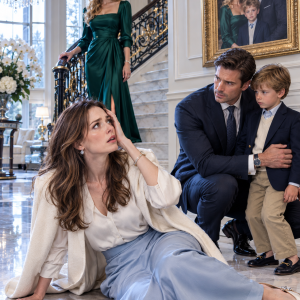
“Do you remember my birthday cake, your mother’s demand for the condominium, and every occasion when silence protected you?”
Tears entered his eyes.
“I remember everything differently now.”
“The events have not changed, Nathan. Only the consequences have forced you to look at them.”
Patricia stepped closer.
“I am begging you to forgive us and ask your father to restore their positions.”
Her request exposed the purpose beneath their apologies.
“If I remained the powerless administrative employee you mocked outside the courthouse, would everyone be sitting here today?”
Nobody answered.
“If my father were not Richard Carter, would you describe my dignity as something worth recovering?”
Their silence provided the only honest response they had offered.
Part 6: Privilege Was Not Talent
My father entered from the adjoining library after hearing enough of the conversation. He sat beside me and addressed Nathan directly.
“On your wedding day, I requested only that you treat my daughter with kindness. You did not need to know my corporate title before honoring that promise.”
Nathan looked down at his hands.
“I allowed my family to determine how I treated her.”
“You watched her become ill, isolated, and exhausted, yet defending her always seemed less important than avoiding discomfort.”
My father then turned toward Patricia.
“Emily asked me for years not to interfere because she believed your family would eventually recognize her loyalty. I honored her wishes while watching everyone accept opportunities she created and treat her like unpaid help.”
Patricia lowered herself to her knees, and the four terminated relatives followed. Nathan remained standing for several seconds before kneeling beside them.
Their posture brought me sadness rather than satisfaction. They had never lowered themselves when I was ill, lonely, or publicly humiliated. Power had produced a respect that humanity never received.
“Mr. Carter, please help our children recover what they lost,” Patricia pleaded.
My father’s response remained measured.
“I did not take their futures. I stopped allowing my daughter to protect them from documented failures. Now they must compete under the same standards applied to everyone else.”
Gregory looked toward me.
“Is there truly no path back?”
“Returning you would punish employees who earned their positions without secret intervention,” I answered. “Mercy cannot become permanent immunity from accountability.”
Before leaving, Nathan requested a private conversation. He removed a letter from his coat, explaining that he had discovered it among my remaining belongings.
I had written it months earlier but never delivered it. The letter said I did not need luxury, public recognition, or an impressive husband. I needed a partner who stood beside me when doing so carried a personal cost.
“I understood what you needed only after making it impossible to give you,” he said.
“Understanding too late is sometimes the consequence rather than the cure.”
“Could you ever forgive me?”
“I already have, because anger should not govern the rest of my life. Forgiveness does not reverse the divorce or reopen the relationship.”
For the first time during our marriage or afterward, Nathan accepted my boundary without arguing.
My father watched their vehicles leave the estate before speaking.
“You helped them because generosity came naturally, but generosity without limits taught them that consequences belonged to somebody else.”
“I thought protecting them would eventually make them treat me as family.”
“Love that must be purchased through rescue will always demand another payment.”
Part 7: Beginning Without Borrowed Influence

Three months later, my father appointed me to manage a newly created regional development division. He announced the decision privately before presenting it to the board.
“This responsibility is not yours because you are my daughter. You earned it by rescuing neglected projects, understanding employees, and correcting problems without seeking applause.”
I accepted on the condition that recruitment and promotion procedures would become fully transparent. No relative of an executive could bypass evaluation requirements, while internal candidates would receive documented opportunities for advancement.
During my first leadership meeting, I told the team that assistance should create capability rather than dependence. My history with the Walsh family had taught me that helping someone was not the mistake; removing every consequence after repeated irresponsibility was.
Gregory eventually accepted a supervisory position at a smaller distribution company for less than half his previous salary. Without assistants repairing his reports, he learned the daily discipline his title had concealed.
Allison returned to an entry-level sales role and completed formal training. Trevor sold his expensive vehicle, reduced his debt, and joined a local property-services company. Chloe enrolled in accounting courses before obtaining a junior position appropriate to her actual experience.
Patricia adjusted to managing her own household and expenses without a daughter-in-law available for instruction. A former neighbor later told me that she had once admitted something quietly over coffee.
“Emily was the most generous person who entered this family, and I was too arrogant to recognize generosity unless it arrived with a prestigious name.”
Nathan moved into a small rental apartment in Cherry Hill and continued operating his facilities-maintenance business without referrals from Hawthorne Meridian. Several contracts ended, forcing him to improve his pricing, service records, and client relationships.
Months later, we encountered each other at a café near Rittenhouse Square. He looked tired but steadier, wearing work clothes rather than the polished suits he once used to imitate success.
“You look genuinely happy,” he said after asking permission to sit briefly.
“I am happy because my life no longer requires constant permission.”
He told me that counseling had helped him understand how often he called avoidance loyalty. He had believed siding with Patricia preserved family unity, even when that unity depended upon my silence.
“Thank you for not destroying us when you possessed enough power to do so,” he said.
“I never wanted to destroy anyone. I simply stopped rescuing people who interpreted rescue as evidence of their superiority.”
When we separated, he did not ask me to reconsider the divorce. That restraint represented the first meaningful respect he had offered.
Part 8: What My Name Finally Meant
A year after the courthouse call, our new regional division opened a training program for employees without executive connections. Candidates received mentorship, measurable goals, and genuine opportunities based upon demonstrated work.
At the opening session, a young administrative assistant asked whether professional kindness always became dangerous when people failed to appreciate it.
“Kindness is not dangerous,” I explained. “The danger begins when kindness has no boundaries and shields someone repeatedly from responsibilities they are capable of carrying.”
Her question returned me to the eight years when I believed silence proved humility. I had hidden my authority to test whether Nathan loved me without it, but I continued the experiment long after the answer became obvious.
My father had been correct: simplicity was honorable, while self-erasure was not.
I did not regret beginning our relationship without announcing my inheritance. I regretted believing that enduring contempt might eventually transform it into affection. People who required me to remain small were never protecting love; they were protecting the arrangement that allowed them to feel large.
On the anniversary of the divorce, I returned to the courthouse for an unrelated property-development hearing. The same marble corridor appeared ordinary without the Walsh family’s laughter surrounding me.
I remembered Patricia predicting that I would return begging because New York and Philadelphia were too expensive for a woman they considered powerless. I remembered Gregory promising to apologize if his employment disappeared, although his eventual apology had arrived only after discovering my identity.
Their disbelief no longer mattered.
Outside, my father waited beside the courthouse steps because we were attending a board luncheon together. He looked toward the judgment folder I still carried for the development matter.
“Does this place bring back difficult memories?”
“It reminds me how calm freedom can feel before anyone else recognizes it.”
We walked toward the waiting car while pedestrians moved through the afternoon light. I no longer used wealth as something to hide, nor did I present it as proof of personal worth. It was simply one part of my life, accompanied by responsibilities that required integrity.
The marriage ended when I signed the judgment, but the deeper change occurred when I stopped asking whether boundaries made me unkind.
My former family had believed my value appeared overnight when they discovered my title, inheritance, and influence. In reality, everything valuable had already been visible: I worked, cared, forgave, solved problems, and offered loyalty without demanding public credit.
They ignored those qualities because they respected power more readily than character.
I could not change what they valued, but I could decide whether they continued benefiting from what they had refused to honor.
Being a good person never required accepting humiliation, and forgiveness never required returning privileges to people who apologized only after losing them.
My name had always opened important doors, yet the greatest freedom arrived when I finally closed one myself.
THE END