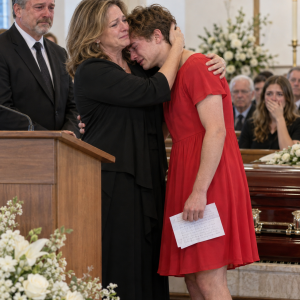
For the first time, Marissa’s expression softened.
Part 5 – The Recording in the Courtroom

The hearings drew intense media attention. Nolan entered the courthouse in a tailored suit, while Marissa followed Naomi with her shoulders straight.
Before proceedings began, Nolan passed close enough to whisper to his sister.
“Say the recording was created during one of your episodes, and I can still arrange supervised contact with Caleb.”
Marissa looked directly at him. “You depended on my fear longer than you deserved.”
Naomi’s presentation began with the authenticated recordings. A digital forensics expert testified that the files had not been edited, generated, or altered. Metadata placed the recorder inside Marissa’s home, while Nolan’s phone records confirmed his presence during the conversation.
When Nolan’s recorded threat filled the courtroom, nobody moved.
“I only need frightened people, official paperwork, and a judge too busy to examine the details.”
The judge admitted the recording after prosecutors established its chain of custody.
Financial investigators then documented Nolan’s debts and his attempts to borrow against the farmhouse. Dr. Ross, facing overwhelming evidence, accepted a cooperation agreement and admitted that Nolan paid him to fabricate evaluations. Ross also confessed that he contacted the hospital before Marissa arrived so staff would interpret fear and confusion as symptoms of mental illness.
The former employee described helping transport the wrapped body. He began crying when asked why he never checked what was beneath the blanket.
“Mr. Pierce paid my wages, and I told myself that asking questions would cost my job.”
The statement echoed through Grant because it sounded like another version of every passerby who had refused to lift the dumpster lid.
Caleb testified through a child-sensitive video system rather than facing Nolan directly. His voice remained quiet, but every word carried the clarity adults had denied him in the alley.
“I saw Uncle Nolan push my mother into his truck after she stopped moving. I followed on my bicycle because I thought he was taking her to the hospital. He left her behind the market, then told me she had gone away because she did not want me anymore.”
The child advocate asked why Caleb stayed beside the dumpster overnight.
“I heard my mother tap three times. She always tapped three times on my bedroom door before coming inside. I knew she was telling me she was still there.”
Grant lowered his head while Marissa covered her mouth.
The judge terminated the psychiatric hold immediately and restored Marissa’s parental rights. Nolan was denied bail after the court reviewed the threat sent to Grant’s office. The judge also ordered an independent investigation into hospital procedures that had allowed unverified records to override a victim’s account.
“This case demonstrates the danger of treating official language as more credible than lived evidence merely because one arrives on letterhead,” the judge said. “A child repeatedly told adults where his mother was, and nearly every adult decided disbelief was easier than action.”
Part 6 – What Remained After the Headlines

Nolan later pleaded guilty to kidnapping, attempted manslaughter, financial exploitation, fraud, and conspiracy. He received a lengthy state prison sentence. Dr. Ross lost his medical license permanently and received additional penalties for falsifying records and obstructing the investigation.
Marissa recovered the farmhouse and Caleb’s education account. Rather than selling immediately to the developer, she leased part of the land to a community agriculture program and used the income to open a neighborhood bakery near downtown Louisville. She named it Three Taps, honoring the signal Caleb recognized through the dumpster wall.
Grant funded a legal advocacy center employing attorneys, social workers, and patient advocates for families harmed by fraudulent guardianship petitions and coerced evaluations.
Months after the trial, Marissa invited him to the bakery’s opening. Caleb stood behind the counter wearing an oversized apron while explaining the difference between cinnamon rolls and sticky buns to anyone willing to listen.
The old dumpster was gone, replaced by a mural of many hands lifting a heavy lid. Beneath it appeared the words: Believing is often the first step toward looking.
As autumn settled over the city, Grant, Marissa, and Caleb walked along the river after closing the bakery. Caleb held his mother’s hand with one hand and carried Fox beneath the other arm.
“Mr. Grant, are you still rich?” he asked.
Grant smiled. “According to several accountants, unfortunately.”
“Then can rich people learn things regular people already know?”
Marissa laughed softly. “That depends on whether they stop talking long enough.”
Grant looked toward the darkening water before answering.
“Sometimes they learn after discovering that power cannot repair the moment when they first chose comfort over courage.”
Caleb considered this, then slipped his free hand into Grant’s.
“You still came back.”
Grant understood that the boy was not offering forgiveness as a prize. He was simply naming the fact that had allowed everything else to happen.
Their lives did not become perfectly arranged. Marissa attended trauma counseling, Caleb sometimes hid food because safety still felt temporary, and Grant occasionally tried solving emotional problems with money rather than patience. Nevertheless, they learned that healing meant returning, listening, and remaining present after public attention moved elsewhere.
On the first anniversary of Marissa’s rescue, they returned to the mural with Detective Price, Naomi, and several volunteers from the advocacy center. Caleb placed a small paper fox beneath the painted hands.
“This is for everyone who asked for help before somebody listened,” he said.
Nobody applauded immediately because the words deserved silence first.
Grant looked around at the people gathered in the alley and remembered the evening when he had valued a business dinner more than a child’s terror. He could not rewrite that moment, yet he could allow it to remain uncomfortable enough to guide every decision afterward.
The city continued rushing around them, filled with traffic, appointments, and private worries. Somewhere, another frightened voice was probably telling a story that sounded inconvenient, exaggerated, or impossible.
Grant now understood that listening did not require blind acceptance, but it did require stopping long enough to investigate.
For Marissa, justice meant more than Nolan’s sentence. It meant regaining the right to define her own mind after powerful men had tried to label resistance as illness. For Caleb, justice meant knowing that the three taps he heard were real, even when strangers dismissed him. For Grant, justice began with admitting that the worst thing about indifference was how ordinary it felt while it was happening.
Caleb squeezed both their hands as they left the alley.
The stuffed fox remained tucked safely beneath his arm, no longer carrying evidence, threats, or secrets. It was simply a child’s toy again, worn from love rather than fear.
That quiet transformation mattered more than every headline that had followed the trial.
THE END