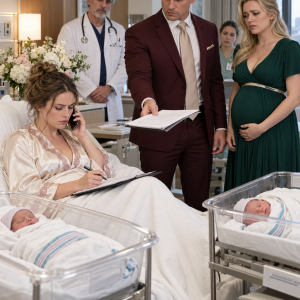
Lily remained in neonatal intensive care for seven weeks.
Hannah visited daily after her own discharge, sitting beside the incubator for hours while Lily gained weight and gradually learned to breathe without mechanical support. Caleb attended every day, although he did not treat his presence as proof that Hannah owed him reconciliation.
They rarely discussed the future of the marriage.
Caleb began individual therapy to understand why Lorraine’s suspicions had entered his thinking so easily. His father had left when Caleb was nine after a marriage filled with accusations, surveillance, and public conflict. Lorraine spent the following years insisting that betrayal existed inside every loving relationship and only foolish people failed to anticipate it.
Caleb had mistaken inherited fear for wisdom.
When Lily was finally cleared to leave the hospital, Hannah established several conditions.
Lorraine would not receive their address, medical information, photographs, or access to the child. Every lock would be replaced because Lorraine previously held an emergency key. Any attempt at indirect contact through relatives would be documented and reported.
“These are not requests,” Hannah said. “They are the conditions under which Lily and I will return home.”
“I understand.”
“If your mother contacts you, I need to know immediately.”
“You will.”
“I cannot remain married to someone who asks me to trust him while deciding privately which truths I am allowed to hear.”
Caleb nodded.
The locksmith arrived that afternoon.
He also removed the damaged wedding portrait from the bedroom wall. Blood remained beneath the cracked glass, and Caleb intended to throw the entire frame away.
Hannah stopped him.
“Replace the glass.”
He looked at her.
“Why would you want to keep it?”
“Because the marriage did not become false simply because the picture was damaged. Whether it survives depends upon what we build after the damage.”
The statement was not forgiveness.
It was permission to begin proving that change could exist.
Part 5 – The Difference Between Remorse and Repair

Caleb moved into the guest room and accepted that Hannah might eventually ask him to leave completely.
He handled nighttime feedings after Lily came home, attended pediatric appointments, and followed every boundary without requesting praise. When relatives called Lorraine’s prosecution unfair, he corrected them instead of asking Hannah to defend herself.
“My mother heard a medical emergency and prevented assistance,” he told his aunt. “The criminal case exists because of her decisions, not because Hannah is vindictive.”
His construction firm reassigned him temporarily to local projects so he could remain near home. Caleb had once treated career flexibility as something Hannah should provide automatically. He now recognized that partnership required him to rearrange his own ambitions as well.
Hannah also began therapy, although her recovery followed a different path.
She struggled to trust her body after years of Lorraine calling every symptom exaggerated. Even after surviving surgery, Hannah sometimes questioned whether pain deserved attention or whether requesting help would make her burdensome.
Dr. Fletcher reminded her that recognizing danger was not selfishness.
The criminal case ended with Lorraine pleading guilty to reckless endangerment and interference with emergency communication. She received supervised probation, mandatory counseling, community service, and a protective order prohibiting contact with Hannah for three years.
The court also barred her from approaching Lily without written parental permission.
Lorraine sent Caleb a letter describing her therapy and asking whether she could see a photograph of the child.
He gave the unopened letter to Hannah.
“You decide whether we read it.”
Hannah placed it inside a drawer.
“Not yet.”
Caleb did not argue.
Ten months after Lily’s birth, he and Hannah attended their first joint counseling session focused on whether the marriage could continue rather than simply how they would parent.
The counselor asked Caleb what he wanted Hannah to understand.
He considered the question.
“I want her to know that I regret doubting her.”
Hannah’s expression remained guarded.
The counselor looked at him.
“Regret describes your discomfort about the past. What responsibility are you accepting for the future?”
Caleb answered more slowly.
“I am responsible for challenging suspicion before acting upon it. I am responsible for protecting our boundaries even when confrontation makes me uncomfortable. I am responsible for listening to Hannah’s account without comparing it against the story my mother taught me.”
Hannah looked toward him.
“That is closer.”
Trust returned in small moments rather than declarations.
Caleb informed Hannah when Lorraine attempted to contact his employer. He declined a family holiday gathering after relatives insisted Lorraine deserved forgiveness before accountability. He stopped describing neutrality as fairness when one person was clearly causing harm.
Hannah, in return, gradually allowed him to participate in decisions without assuming every question concealed disbelief.
Neither pretended that the process was romantic.
Repair looked like schedules, transparency, difficult conversations, and the repeated choice not to return to easier patterns.
Part 6 – The Photograph Behind New Glass

Lily’s first birthday took place in a waterfront park beneath wide oak trees and clear spring sunlight.
She had grown from a premature infant surrounded by machines into a determined child who disliked remaining still. Hannah placed her several feet away on the grass, then opened both arms.
Lily took one step, paused, and took three more before falling into her mother’s lap with delighted laughter.
Caleb photographed the moment.
The image contained no shattered frame, unknown jacket, or blood. It contained Hannah laughing while Lily gripped her shoulders beneath the morning light.
Lorraine sent another letter that week. She wrote that counseling had helped her recognize how fear, resentment, and abandonment shaped her need to control Caleb’s relationships. She asked for a supervised meeting.
Hannah read the letter and returned it to the drawer.
“Not now.”
“Not now,” Caleb repeated.
He understood that Lorraine’s progress did not create automatic access to the people she endangered.
Hannah looked at him.
A scar remained between them, although it no longer controlled every conversation.
She reached for his hand.
“Do you know what hurt most that night?”
“That I doubted you.”
“Yes, but there was something else. Your mother had called me dramatic so often that I started believing her. I waited when the pain began because I was afraid the hospital would think I was wasting their time.”
She watched Lily attempting to stand again.
“I never want our daughter to learn that enduring pain quietly makes her easier to love.”
“She will not learn that from us.”
Caleb did not promise perfection. He promised to ask questions before reaching conclusions, to treat requests for help seriously, and to speak when silence would protect harm.
Several weeks later, they rehung their wedding photograph.
The original frame had been repaired, and the broken glass had been replaced. A faint discoloration remained near one corner where the blood could not be removed completely.
Caleb suggested restoring it further.
Hannah declined.
“The mark belongs to the story, but it does not cover the entire picture.”
Their marriage never returned to the uncomplicated version that existed before Lily’s birth. That version had depended upon avoidance, unspoken resentment, and Caleb’s belief that he could remain neutral between cruelty and the person receiving it.
The relationship they built afterward was more demanding and more honest.
Hannah no longer minimized discomfort to appear reasonable. Caleb no longer interpreted conflict as something dangerous merely because his mother disliked boundaries. Neither of them used Lily as evidence that the marriage had healed.
They measured repair through everyday behavior.
One evening, Caleb returned home and found Hannah asleep on the sofa while Lily rested against her chest. A medical envelope lay unopened on the table.
Once, he might have opened it and decided which information Hannah needed immediately.
Instead, he placed dinner in the refrigerator, covered both of them with a blanket, and waited until Hannah awakened.
“A letter arrived from your doctor,” he said. “Would you like to open it now or tomorrow?”
Hannah studied him briefly.
“Tomorrow. Tonight I only want tea.”
He prepared it without asking another question.
Steam rose above the cups while Lily slept between them.
The night of the emergency had once seemed like the moment Caleb discovered a hidden betrayal. In truth, it exposed several older deceptions.
Lorraine had called control protection. Caleb had called cowardice neutrality. Hannah had called silent endurance strength because she feared becoming inconvenient.
None of them could return to those stories.
Outside, harbor lights moved across the water. Caleb looked toward the repaired wedding photograph hanging above the staircase.
The glass was new.
The image remained the same.
What had changed was their willingness to see everything surrounding it.
THE END