The House at the End of Orchard Lane

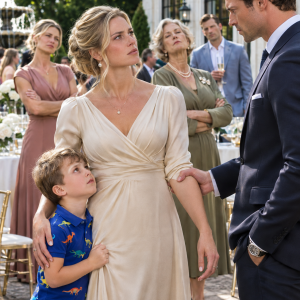
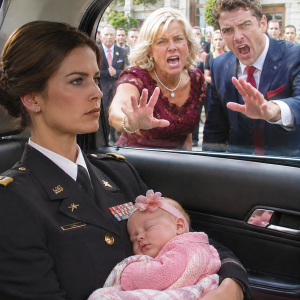
The first thing I noticed was the cold. It slipped through my hospital cardigan and settled against my skin while I stood on the front porch with my five-day-old daughter tucked against my chest, listening to my mother-in-law tell her son that my baby did not belong in her house.
“Until you can prove that child is a Langley, she doesn’t come through this door,” Patricia said. Her voice carried through the narrow opening, clear enough to reach the sidewalk. “I’m not raising somebody else’s baby under my roof.”
I had been home from the hospital for less than an hour. The stitches from my delivery pulled when I shifted my weight, and my daughter, June, had begun to fuss beneath the pale blanket around her. Two canvas bags and a small suitcase sat by my shoes. I had left them there only long enough to get the key into the lock.
Patricia stood in the doorway with one hand braced against the frame. She wore a pale blue sweater and the expression she had used for years whenever she wanted me to understand that I had disappointed her.
“Please,” I said, trying to keep my voice even. “June needs a clean diaper. Let me come inside for a few minutes.”
“You heard me, Molly.”
The door closed before I could answer. For a moment I remained on the porch, holding my daughter close and staring at the brass handle as though it might turn again if I waited long enough.
My husband, Scott, had promised he would be home from a fishing weekend before we were discharged. Two days earlier, when I reminded him I would be leaving the hospital the next morning, he had sounded impatient rather than surprised.
“Mom can pick you up,” he had said. “She’ll get you settled. Don’t make this harder than it needs to be.”
Patricia never came. I had called a cab and carried our bags out of the hospital with a nurse’s help, telling myself that Scott must have lost track of the time, or that the road trip had taken longer than he expected. I had repeated those explanations all the way home, because they were easier to hold than the thought that my husband had simply chosen not to show up.
Now I called him three times. Each call went unanswered. I sent a message telling him his mother had locked us out, that I was standing outside with June, and that I needed him to call me as soon as he saw it. The message showed as read. The phone stayed silent.
For four years, I had tried to think of Patricia’s sharpness as a flaw I could work around. Scott had made that easy by treating her criticisms as harmless habits.
“That’s just how Mom is,” he would say when she questioned my cooking, my clothes, or the fact that I had kept my own last name after we married. “Try not to take it personally.”
I had tried. When I became pregnant, I hoped the baby might soften something in her. Instead, the first time Patricia visited the hospital nursery, she studied June’s face and said the baby looked nothing like Scott’s family.
“She’s a newborn,” I replied, too tired to argue.
“I know my son,” she said, and turned away.
That evening Scott asked whether I had really spent a weekend at my friend’s house the previous year while he was away for work. It was the first time either of us had questioned our marriage in that way, and he asked the question as if he already knew the answer.
I had been so stunned that I could only look at him and say that he knew where I had been. He didn’t apologize. He said his mother had been worried and that he was only asking.
On the porch, with the day slipping toward evening, I thought about the one place I could go without asking anyone’s permission: the small house my grandmother had left me outside Briar Glen. Scott had always called it an old ruin, but the deed was in my name, and I still had the key on my ring.
I put June’s things back into the suitcase, found another cab, and gave the driver the address.
The House Beyond the Orchard
Grandma Lillian’s house sat beyond a narrow road lined with maple trees, its green shutters faded by years of weather and its front steps worn in the middle from generations of shoes. An old apple tree leaned over the side yard, and behind the house stood a little shed that had once held gardening tools, spare boards, and all the things Grandma never wanted to throw away.
I had visited every summer as a child, but after her health began to fail, my trips became less frequent. By the time I married Scott, I had convinced myself that the house belonged to a quieter part of my life, a place I loved but had no real use for.
As the cab pulled away, I realized I had no idea whether the furnace worked. I let myself in, carried June to the bedroom, and laid her carefully in the bassinet I had brought from the hospital. The rooms smelled faintly of cedar and closed windows. Electricity still worked, but the house had been shut up through much of the fall, and the air felt cold enough to sting my hands.
I wrapped June more snugly and went out to look for firewood. The shed door stuck when I tried to open it, and I was tugging at it with one hand when a man called from the other side of the fence.
“Hey, can I help you? I wasn’t expecting anyone out here.”
I turned so quickly that the latch slipped from my fingers.
“I’m Molly Ellison,” I said. “Lillian Mercer was my grandmother. This house belongs to me.”
The man came closer, his expression changing as he looked from my face to the hospital bracelet still around my wrist. He was tall, broad-shouldered, with dark hair touched by a little gray at the temples and the kind of short beard that made him look more serious than he seemed.
“Molly?” he asked. “It’s Sam. Sam Whitaker. I used to live next door.”
For a second, the years folded together. I remembered a skinny boy with scraped knees who had fixed the chain on my bicycle and once walked beside me all the way to the corner store because I was afraid of a loose dog. I had called him Sammy until the summer he grew taller than me.
“Sammy?”
He smiled, then glanced at the baby.
“You just had her?”
“Five days ago.”
His gaze moved back to my face. “Is your husband with you?”
I looked down at June’s blanket. “No. He didn’t come to get us.”
Sam’s smile disappeared. He looked toward the cold house, then at the empty wood rack near the shed, and his face took on the quiet focus of someone deciding what needed to be done.
“I’ve been taking care of this place for a few years,” he said.
I stared at him. “Why?”
“Your grandmother was good to me when I was young. I had more dinners at her table than I can count. I figured the least I could do was keep the roof from giving up on her.”
He did not explain further. He took the basket from my hand and went to his own woodpile, returning with dry logs tucked under one arm. Then he checked the old stove, examined the flue, and made sure the smoke was drawing before he lit a careful fire.
“Don’t use it by yourself until you know how it works,” he said. “I’ll come back in the morning and check the draft.”
That night, June and I slept in a warm room. I did not sleep much, but I stopped shivering, and every time she stirred, I could hear the wind pass outside instead of through the walls.
In the morning, a truck pulled up beside the shed. Two workers unloaded a stack of firewood while Sam stood nearby, talking them through where to put it. I stepped onto the porch, still wearing my hospital cardigan, and watched them build a neat pile under the little roof.
“Sam, you can’t do all this for free,” I said when he came over.
“I didn’t say I was doing it for free. You can pay me back when you’re on your feet.”
“I don’t want charity.”
He met my eyes, not offended, only steady.
“Accepting help isn’t the same as giving up your independence, Molly. You’ve got a new baby and a house that’s been closed up for months. Let the firewood be firewood.”
He brought groceries, too: eggs, bread, milk, and diapers in the right size. I tried to object, but June began fussing, and the kindest thing I could do was feed her instead of arguing with someone who was only trying to make the day easier.
Over breakfast I told Sam what had happened, slowly at first and then all at once, as though the words had been waiting behind my teeth. I told him about Scott’s unanswered calls, his mother’s accusation, the door closing in my face, and the message he had read without replying.
Sam listened without interrupting. When I finished, he sat quietly for a moment.
“Does Scott know where you are?”
“He can probably guess.”
“Then he knows you’re here alone with a newborn.”
The sentence landed harder than anything Patricia had said. I knew it was true, and I hated that it was true.
That evening, Scott finally sent a message.
I’m back. Mom and I will come by tomorrow. We need to talk.
He did not ask how June was doing.
A Test Couldn’t Repair a Promise

The next afternoon, Scott’s truck pulled into the drive. Patricia climbed out first, surveyed the house, and then looked at Sam, who was repairing a loose board on the porch.
“Well, look at this,” she said to Scott. “She’s been here less than a week and she already has another man fixing up the place.”
“He’s my neighbor,” I said.
Sam set down his tools and straightened, but I lifted a hand slightly to let him know I could handle it.
Scott came up the walk with his shoulders drawn in and his eyes fixed on the porch boards.
“Mom was upset,” he said. “Let’s go home and sort this out.”
For a moment I wondered whether he could hear himself. Home was not the word I would have chosen for the house whose door had been shut in our faces, or for the family that had let me stand outside with our daughter while my husband ignored my calls.
“You left me on a sidewalk with a newborn,” I said. “You read my message and chose not to answer.”
He looked down. “I thought you’d work it out with Mom.”
“You thought I’d work it out with the woman who had just locked us out?”
Patricia crossed her arms.
“You could have avoided all of this by telling the truth from the beginning.”
I looked at Scott. “Do you believe June is your daughter?”
He hesitated. It was only a second, but I saw it. His eyes moved toward his mother, then back to me.
“A test would settle things,” he said.
Something inside me went still. For years, I had believed marriage was made of small acts of trust: showing up, giving the other person the benefit of the doubt, remembering what they had told you. Scott had asked me to prove the one thing he should never have needed to question.
“All right,” I said. “We’ll do the test.”
Patricia’s mouth lifted at one corner, as if she had won something.
“Good. Once we know, you can come home.”
“I’m not coming back.”
Her smile vanished. Scott looked at me as if I had said something he could not quite understand.
“Then what’s the point of the test?”