The Little Girl Who Asked a Stranger If He Was Lost

The first time a little girl asked me whether I was lost, I was standing in the middle of an airport with a first-class boarding pass, a perfectly organized schedule, and more money in my savings account than I had ever imagined having when I was young. I knew exactly which gate I needed, how long my flight would take, and what I intended to accomplish when I arrived, yet the question she asked me that morning would eventually make me realize how little any of those things mattered when I no longer knew how to find my way back to the people I loved.
My name is Daniel Whitaker, and I was fifty-eight years old when that happened.
A Small Voice in a Crowded Airport
It was a Thursday morning in early October, and Chicago O’Hare was as busy as I had ever seen it, with travelers hurrying between terminals, rolling suitcases rattling across the polished floors, and announcements echoing above the steady conversations of people heading somewhere important.
I was waiting for a flight to Denver, where I was supposed to meet with the directors of a regional hospital network about a consulting project that had occupied most of my attention for the previous six weeks. After nearly thirty years working in healthcare administration and facility planning, I had developed a reputation for solving expensive problems, negotiating difficult agreements, and keeping complicated projects moving when everyone else seemed ready to give up.
I was good at my work, and for a very long time, I had allowed that to become the most important thing about me.
That morning, I was standing near a row of windows, answering an email on my phone, when someone gently touched the sleeve of my jacket.
I glanced down and found a little girl looking up at me.
She couldn’t have been more than five or six, with soft blonde curls escaping a crooked ponytail, a pale pink sweater, and a bright turquoise backpack that seemed almost too large for her narrow shoulders. Her cheeks were damp, and although she was clearly trying to be brave, her lower lip trembled as she gathered enough courage to speak.
“Excuse me, mister. Are you lost, too?”
For a moment, I thought I had misunderstood her.
“Lost?” I repeated, lowering my phone.
She nodded solemnly.
“Because you keep looking at that thing, and you look kind of sad. My mommy says people look at their phones when they don’t know what to do.”
I stared at her, uncertain whether to smile or ask why she was wandering around by herself, until I noticed how tightly she was gripping one of her backpack straps.
“Where’s your mom, sweetheart?”
Her eyes immediately filled again.
“I don’t know. She told me to stay near the blue chairs, but there were so many people, and I thought I saw her coat, so I followed it. Then it wasn’t her.”
I put my phone away and crouched until we were at eye level.
“What’s your name?”
“Ellie.”
“Well, Ellie, I’m Daniel. We’re going to find someone who works here, and they’ll help us find your mom. You don’t have to figure this out by yourself.”
She studied my face with the seriousness children sometimes have when deciding whether an adult can be trusted.
“Promise?”
“I promise we’ll get you some help.”
I pointed toward a nearby airline service desk, where two employees were assisting passengers, and explained that we could walk over together without going far from where she had last seen her mother.
Ellie slipped her small hand into mine.
That simple gesture brought back a memory I hadn’t thought about in years.
My daughter, Claire, used to hold my hand exactly that way.
The Life I Had Been Too Busy to Notice
Claire was thirty-one now, living in a small town outside Columbus, Ohio, and she hadn’t answered one of my phone calls in nearly seven months.
I knew her address, her birthday, and the name of the elementary school where she taught fourth grade, but I didn’t know what she had eaten for breakfast, whether she was happy, or what she did on Sunday afternoons.
I didn’t even know whether she still kept the old family photographs that had once lined the hallway of our house.
My marriage had officially ended four weeks earlier, after twenty-nine years together, although my former wife, Margaret, had told me that she had felt alone for much longer than that.
When she first said those words, I remember thinking they were unfair.
I had provided a comfortable home, paid for family vacations, made sure Claire could attend college without worrying about tuition, and worked hard enough that Margaret never had to wonder whether we could afford the ordinary things families needed.
What I hadn’t understood was that providing for people and being present for them were not always the same thing.
I missed school concerts because a meeting ran late, birthdays because flights were delayed, and quiet evenings because someone at work needed another report before morning.
Whenever Margaret asked me to slow down, I assured her that things would settle once the next project was finished.
There was always another project.
By the time I began to notice the silence at our dinner table, Claire had moved away, Margaret had stopped asking me to come home early, and I had become a visitor in a house I was still paying for.
Three weeks before the airport encounter, I had stood in our kitchen while Margaret packed the last of her belongings into cardboard boxes.
She had looked around the room and said, “Daniel, I spent years waiting for you to come home, even when you were already here.”
I wanted to argue, but I couldn’t think of anything to say that would make her wrong.
Now, walking slowly beside a frightened little girl, I found myself remembering all the times Claire had reached for my hand when she was young, and how gradually, without either of us recognizing the moment, she had stopped.
The Question That Stayed With Me

Ellie took two small steps for every one of mine, so I shortened my stride as we made our way toward the service desk.
Ordinarily, I moved through airports with the impatience of someone who believed every minute should be used efficiently, but Ellie seemed concerned with entirely different things.
She noticed a little boy carrying a stuffed dinosaur, a woman wearing shoes that sparkled under the overhead lights, and an airplane moving slowly beyond the windows.
“Do you fly a lot?” she asked.
“More than I probably should.”
“Why?”
“Mostly for work.”
She considered that answer.
“Do you like your work?”
I almost answered automatically, but something about her curiosity made me think before speaking.
“I used to like it a lot.”
“What about now?”
I looked down at her.
“I’m not sure.”
Ellie seemed satisfied with my honesty, although she had another question waiting.
“Do you have kids?”
“I have a daughter. She’s grown up now.”
“Does she still like you?”
I couldn’t help laughing softly, not because the question was funny, but because it was so direct that I had no way to hide behind a polite answer.
“I hope she does.”
“You don’t know?”
“We haven’t talked much lately.”
Ellie frowned.
“My mommy says you have to talk to people if you want them to know you love them.”
I stopped walking for a moment.
My daughter had been trying to tell me something similar for years, though she had used longer sentences and sometimes spoken through tears.
Ellie tugged gently at my hand.
“Maybe you should call her.”
“Maybe I should.”
“My mommy says sometimes grown-ups make easy things hard.”
I smiled, although my throat had tightened.
“Your mom sounds pretty smart.”
“She is. She knows how to fix almost everything.”
We reached the desk, where a young employee named Rebecca immediately listened to what had happened and contacted airport security. She asked Ellie a few gentle questions about her mother, her clothing, and the last place they had been together, while another employee notified the appropriate staff.
I remained nearby because Ellie had not released my hand.
A few minutes later, just as Rebecca was confirming the description of Ellie’s mother, a woman’s voice rose above the airport noise.
Related Posts

“YOU’RE NOT HERE TO RELAX! GET OFF YOUR LAZY SELF AND START CLEANING!” My Sister-in-Law Snapped, Shoving A Chore List In My Face The Moment We Arrived At The Beach House. I Turned To My Husband, Furious. He Sneered, “STOP WHINING! YOU SHOULD BE GRATEFUL MY BROTHER EVEN LETS YOU STAY HERE!” Then He Tossed Me His Credit Card And Left To Go Fishing. I’d Worked Overtime For Ten Months To Pay For Our Dream Vacation, But He’d Secretly Canceled My Resort. When I Checked Our Savings Account, Almost $3,000 Had Vanished. Then An Airline Email Arrived—And What I Saw Made Me Grab My Suitcase.

I Hadn’t Spoken to My Father in 20 Years—Until He Rushed Into My Emergency Room Carrying an 8-Year-Old Girl Who Could Barely Breathe. As My Team Fought to Save Her, He Looked at Me and Whispered, “Nathan… She’s Your Niece.” I Had Never Known I Had a Sister, but the Letter She Left Behind Revealed a Secret My Father Had Hidden for Years

“Mom, I Miss Dad So Much. I Tried Not To Cry Because I Thought I Had To Be Strong For You.” My Son Sobbed After Forty-Three Officers Saluted Him At The End Of His Performance. I Had Spent Three Years Believing He Was Hiding From His Grief. I Never Realized He Had Been Trying To Protect Me From Mine.
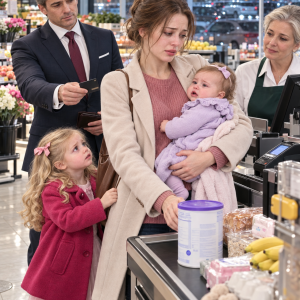
A Wealthy Widower Saw A Single Mother Return Her Baby’s Formula Because She Couldn’t Afford It—But One Unexpected Act Of Kindness Set Four Lives On A Path None Of Them Could Have Imagined.