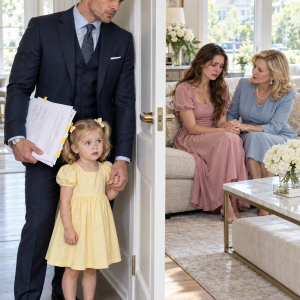
The Day I Stopped Paying for Everyone Else’s Happiness
Twelve hours after I donated sixty percent of my liver to save my ten-year-old nephew, my sister walked into my hospital room, sat on my husband’s lap, and kissed him right in front of me.
“You might as well know the truth now,” she said, smiling. “Your husband is my son’s real father.”
My mother stood beside them, looking almost pleased.
“At least you’ve finally done something useful for this family,” she told me.
Then my husband placed divorce papers and a $5,000 check on my hospital bed.
He thought I was too weak to fight back.
What none of them knew was that my phone had been recording their conversation, my attorney was already listening, and a medical report was about to expose a secret they had spent years hiding.
But the biggest surprise would come months later, when I discovered what my late father had left behind.
The Family I Spent My Life Supporting

My name is Meredith Calloway. I was thirty-four years old, an architect living in New York City, and someone who had spent most of her adult life taking care of everyone except herself.
I owned a successful architectural firm specializing in environmentally friendly buildings. I had worked long hours, missed holidays, and sacrificed countless weekends to build a career I was proud of.
Unfortunately, my family treated my success as something that belonged to them.
My mother, Elaine, had expensive tastes and little interest in managing her own finances. My younger sister, Paige, was always starting another business that somehow required my money.
And my husband, Trevor, enjoyed the lifestyle my career provided without ever acknowledging how much work went into it.
I paid for our Manhattan apartment, our vacations, and most of our daily expenses. I also covered my mother’s mortgage and helped Paige raise her son, Owen.
Whenever I hesitated, my mother reminded me that family came first.
“You’ve been blessed with so much, Meredith,” she would say. “There’s nothing wrong with sharing your good fortune.”
For years, I believed her.
I thought that if I remained generous enough, patient enough, and understanding enough, they would eventually appreciate me.
Then Owen became seriously ill.
The Decision That Changed Everything

Owen was ten when doctors discovered that his liver was failing.
He was a sweet, thoughtful boy who loved model airplanes, building sets, and asking questions about the buildings I designed.
Despite my complicated relationship with Paige, I adored him.
When doctors explained that he needed a liver transplant, I immediately volunteered to be tested.
I was a suitable donor.
The medical team carefully explained the risks and the recovery process. I understood that donating part of my liver would require major surgery and weeks of healing.
Still, when I looked at Owen sitting in his hospital bed, trying to smile despite his exhaustion, my decision felt simple.
“Aunt Meredith, are you sure you want to do this?” he asked.
I sat beside him and held his hand.
“I’m sure, sweetheart. The doctors believe this can help you get better, and I want to give you that chance.”
He hugged me.
“When we’re both better, can we finish building that big bridge?”
“Absolutely,” I promised.
The surgery took place at NewYork-Presbyterian Hospital.
Before they brought me into the operating room, Trevor kissed my forehead.
“You’re doing something wonderful,” he whispered.
Paige stood nearby, wiping her eyes.
“I don’t know how I’ll ever repay you.”
My mother squeezed my hand.
For one brief moment, I believed we were finally acting like a real family.
I had no idea how quickly that illusion would disappear.
Twelve Hours After Surgery
When I woke up, I was exhausted.
Every movement was uncomfortable, and the nurses reminded me to rest while my body recovered.
I asked about Owen almost immediately.
The doctor assured me that his procedure had gone well and that the transplant team was closely monitoring him.
Relief washed over me.
Whatever happened next, Owen had been given a chance.
That evening, Trevor entered my private recovery room with Paige and my mother.
I expected them to ask how I was feeling.
Instead, Trevor quietly closed the door.
Paige walked toward him, settled onto his lap in the visitor’s chair, and kissed him.
At first, I thought the medication was making me confused.
“Trevor?” I whispered. “What are you doing?”
He avoided my eyes.
Paige looked directly at me.
“There’s no reason to pretend anymore, Meredith.”
My heart began racing.
“Pretend about what?”
She wrapped an arm around Trevor’s shoulders.
“We’ve been together for years. Owen is Trevor’s biological son.”
I stared at them.
Owen was ten. Trevor and I had been married for six years.
I tried to understand how much of my marriage had been built on a lie.
“You knew him before we got married?”
Paige nodded.
“We never really stopped seeing each other.”
I turned toward my mother.
“Did you know?”
She sighed, as though I had asked an inconvenient question.
“Meredith, your sister needed stability. Trevor wanted a family, and you’ve always been more interested in your career.”
The words left me speechless.
I had supported Paige for years. I had paid Owen’s school fees, medical expenses, and countless household bills.
And now they were telling me that my husband had been part of her life all along.
The Divorce Papers on My Bed
Trevor removed a folder from his briefcase.
“I think it’s best if we settle everything quickly,” he said.
He placed the folder beside me.
Inside were divorce documents and a cashier’s check for $5,000.
“You can use that money to find another apartment while you recover,” he explained. “Paige and Owen will be moving into the Manhattan place.”
I looked at him in disbelief.
“You want me to leave my own home?”
“It’s been our home for six years, Meredith.”
“I bought it before we married.”
His expression tightened.
“We can argue about technicalities later.”
Paige stepped closer.
“Please don’t make this difficult. Owen needs his father, and we deserve a chance to be happy.”
I looked at the woman whose child I had just helped save.
For years, I had mistaken her dependence on me for affection.
Now she was asking me to surrender my marriage, my home, and my dignity as though they were ordinary gifts.
I didn’t sign anything.
Instead, I reached for my phone.
“I need to call my attorney.”
Trevor laughed nervously.
“You’re barely awake. Don’t make decisions you’ll regret.”
I looked directly at him.
“That’s exactly why I’m calling someone who can think clearly.”
The Call They Never Expected
My attorney, Grant Whitaker, had handled my business affairs for nearly a decade.
He knew how my properties were owned, how my company was structured, and what protections existed in my marriage agreement.
More importantly, he knew how much financial assistance I had provided to my family.
When he answered, I explained what had happened.