PART 1: THE WOMAN ON THE PAVEMENT
The sharp red heel of Vanessa Cole pressed across my fingers while I lay on the rain-soaked pavement outside the Arlington Grand Hotel in Boston, eight months pregnant with the son my husband had once claimed he wanted more than anything in the world.
My husband, Harrison Whitmore, stood less than two feet away in a perfectly tailored black tuxedo, one hand resting protectively against Vanessa’s lower back while she looked down at me with open contempt.
Then Harrison leaned closer and spoke in the controlled tone he always used whenever witnesses were present.
“Caroline, stop embarrassing yourself and apologize to her before this becomes worse.”
For several seconds, the only sound beneath the glass entrance canopy was the steady summer rain striking expensive cars lined along the curb.
Pain traveled from my crushed fingers toward my wrist, while my abdomen tightened hard enough to make me hold my breath.
Our unborn son moved beneath my ribs.
I did not scream, although every instinct inside me wanted to.
Instead, I studied Harrison carefully because observation had become my safest weapon during the previous twenty-three days.
His tuxedo remained immaculate.
His jaw tightened whenever someone nearby raised a phone.
Most importantly, the hand on Vanessa’s back never moved toward me.
He was protecting her while his pregnant wife lay at their feet.
Something inside me became profoundly quiet.
“Take your foot off my hand, Vanessa.”
She tilted her head.
“And what exactly are you going to do if I don’t?”
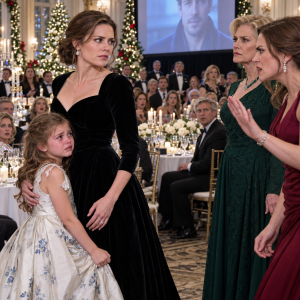
Behind her, guests were entering the annual children’s-hospital fundraiser organized by the Whitmore Foundation.
Bank presidents, hospital executives, private-equity partners, corporate directors, and wealthy donors were gathering inside, where Harrison would soon deliver a carefully polished speech about protecting vulnerable children.
A hotel security officer stood several yards away, visibly uncertain whether he was witnessing an ugly marital confrontation or an assault.
Harrison noticed him.
More importantly, Harrison noticed the phones.
“Vanessa, that is enough.”
Only then did she lift her heel, twisting it slightly before releasing my hand.
The pain cut through my palm.
I pushed myself upward using my uninjured hand, stopping on one knee when pressure tightened across my stomach.
The security officer stepped forward.
“Ma’am, are you injured?”
“Call an ambulance, please.”
Harrison immediately turned toward me.
“You do not need an ambulance.”
I looked directly at him.
“You are not my doctor.”
Then I added the sentence that finally disturbed his confidence.
“I am creating a record.”
For the first time that evening, genuine fear flickered across his face.
The original story establishes the same public confrontation: the heroine is eight months pregnant, the mistress deliberately stands on her hand after causing her fall, and her husband protects the mistress while influential guests begin recording the incident. Văn bản đã dán (1)
PART 2: TWENTY-THREE DAYS OF SILENCE
Twenty-three days earlier, I still believed my marriage was merely sick rather than dead.
The distinction mattered because sick things could sometimes recover.
I discovered Harrison’s second phone while searching his home office for an insurance document requested by my obstetrician.
A charging cable disappeared behind what should have been a solid walnut wall panel.
When I pulled it gently, the panel moved.
Behind it sat a black phone with no case, no family photographs, and no password.
The first message thread contained hotel reservations.
The second contained photographs of Vanessa inside our Lake Wellesley home, sleeping beneath a blanket I had bought during a Vermont anniversary trip.
There were more photographs, more reservations, and a voice message in which Vanessa laughed while asking Harrison when he would finally “deal with Caroline.”
The affair devastated me, although another message frightened me more.
Vanessa had written:
How much longer until the evaluation is complete?
Harrison replied:
Soon. She’s already emotional. The pregnancy helps.
Then came another exchange.
What about the power of attorney?
I’ll get her signature. She signs medical paperwork without reading every page now.
I sat completely still in Harrison’s desk chair while my son moved inside me.
Two nights earlier, Harrison had placed several documents beside my tea and described them as routine hospital contingency forms.
I had signed two pages before the baby kicked and distracted me.
Now I retrieved the duplicate packet from a locked breakfast-room cabinet.
The first pages concerned legitimate medical decision-making.
The later pages did not.
They granted Harrison broad authority over jointly held financial assets if I became medically incapacitated, while an attached document affected voting rights linked to my stake in Whitmore Global Holdings.
Harrison had always encouraged the public mythology that he built the company alone.
The truth was less convenient.
We built it together.
When we were twenty-nine, we survived on takeout while working sixteen-hour days.
At thirty-two, I discovered a debt covenant that could have destroyed our first major expansion.
At thirty-four, I redesigned the voting structure so outside capital could enter without stripping the founders of control.
Harrison excelled in rooms filled with investors.
I excelled at numbers, structural risk, contracts, and details that prevented expensive ideas from becoming expensive disasters.
Then pregnancy became complicated.
Bleeding at twelve weeks.
Bed rest at twenty weeks.
Hospital monitoring at twenty-six.
I withdrew from daily management because keeping our child alive became more important than headlines.
Harrison interpreted that withdrawal as surrender.
I called Rebecca Sloan, the attorney who had represented me personally long before my marriage.
Her first question changed everything.
“Caroline, are you safe?”
I looked toward the security gate outside our home.
“I honestly don’t know anymore.”
“Then assume you are not until we establish otherwise.”
That afternoon, I stopped behaving like a betrayed wife and started behaving like a co-founder protecting evidence.
PART 3: THE DOCUMENTS HE THOUGHT I WOULD NEVER READ

Rebecca helped me duplicate the hidden phone without moving it.
I photographed the paperwork and downloaded account statements.
Two days later, forensic accountant Daniel Cho identified the first suspicious transfer.
Five hundred thousand dollars had moved from an account Harrison believed I no longer monitored.
Then another transfer appeared.
Then another.
The disputed total reached two million dollars.
The money traveled through a consulting entity linked to an office leased in Vanessa’s name.
Harrison had approved the transfers.
Several documents also contained signatures resembling mine.
Almost perfectly.
Almost.
I had signed corporate documents beside Harrison for fourteen years, which meant I knew the unconscious patterns of my own handwriting better than any forger could.
My capital R leaned left.
The forged R leaned right.
We eventually found seven disputed signatures. Văn bản đã dán (1)
Then my obstetrician’s office called.
A nurse politely informed me that they were confirming a referral for an emergency psychiatric evaluation.
I was standing inside the unfinished nursery.
“I never requested a psychiatric evaluation.”
The nurse became cautious.
I asked whether my doctor had ordered it.
She said no.
I asked whether my husband had initiated the request.
The silence on the line answered.
“Please document that I did not request this evaluation and that no medical information may be released to Harrison without my written consent.”
That evening Harrison came home carrying my favorite white roses.
He kissed my forehead.
“How are my two favorite people doing?”
I nearly became physically sick.
Instead, I smiled.
“Tired.”
He rested his palm against my stomach, and our son kicked beneath his hand.
For several terrible seconds, I saw the man I had loved.
The husband who once slept on a hospital floor during an earlier pregnancy scare.
The man who drove through a snowstorm after my mother died because I called him crying.
That was what made everything difficult.
People are easier to leave when every memory is ugly.
Harrison had beautiful memories attached to him.
Beautiful memories did not make his current choices less real.
He handed me another folder.
“Just some hospital forms.”
I understood immediately.
He was trying again.
“Tomorrow.”