The Night Nothing Made Sense

For most of my adult life, I had been the person other people called when something went wrong.
At thirty-seven, I was the founder and chief executive of Whitaker Development Group, a company that had grown from a small Connecticut construction office into a national business overseeing hotels, office towers, and high-end residential properties. I had built my reputation on making decisions quickly, noticing weaknesses before anyone else did, and refusing to leave problems unresolved. In meetings, people came prepared because they knew I would ask the question they had hoped no one would ask. At home, I had carried the same habits with me without realizing it.
Then I became the father of triplets.
Eight months later, I understood how little authority mattered when three babies were crying and nobody could tell me why.
It began on an ordinary Tuesday evening at our home outside Ridgefield, Connecticut. Owen, Luke, and Emma had been fussy after dinner, which was not unusual. Raising three infants taught you quickly that one baby’s bad mood could spread through a room faster than a cold in January. But by seven o’clock, all three were crying harder than I had ever heard them cry before.
The nursery filled with people.
Two caregivers moved between the pale maple cribs, checking bottles, diapers, blankets, pajamas, and room temperature. Someone dimmed the lights. Someone else turned on the small white-noise machine near the bookcase. I carried Emma against my shoulder until my arm went numb, walking the same path across the rug again and again.
Nothing helped.
Our pediatrician, Dr. Rebecca Nolan, lived only twenty minutes away and arrived before eight. She examined each child carefully, then repeated the examinations because I asked her to.
“Their temperatures are normal,” she told me. “Their breathing sounds clear. Ears look fine. I’m not finding anything abdominal, either.”
I looked toward the cribs, where Owen and Luke were still crying while Emma twisted restlessly in my arms.
“Then what are we missing?”
Rebecca hesitated.
I hated hesitation.
Under normal circumstances, I would have filled the silence with another question, then another, until someone gave me an answer. That night, however, I was not a CEO sitting at the end of a conference table. I was simply a father who could not comfort his children.
I called Dr. Aaron Bell, a pediatric hearing and sensory specialist I knew through a hospital foundation. He arrived less than an hour later, still wearing the jacket he had put on for dinner with his wife. He examined the babies, watched their reactions to light and sound, checked their eyes, breathing, reflexes, and responsiveness, and finally turned to Rebecca.
Neither doctor looked alarmed.
Neither doctor looked satisfied.
That somehow frightened me more.
My director of estate operations, Carter Wells, had meanwhile checked everything he could think of. The heating system was working. Carbon monoxide detectors were normal. The windows were secure. The cameras showed nothing unusual. No cleaning products had been used in the nursery that day.
“The room checks out,” Carter said quietly.
“The room does not check out,” I replied. “Three babies who were fine this afternoon are suddenly miserable.”
Before he could answer, one of the caregivers lifted Emma from her crib and carried her into the hallway, hoping a change of surroundings might settle her.
Within seconds, she stopped crying.
The effect was so sudden that everyone noticed.
Emma rested her damp cheek against the caregiver’s shoulder, gave one exhausted little hiccup, and became quiet.
Rebecca looked at Aaron.
I looked at the nursery.
“Bring her back in.”
The caregiver hesitated.
“Mr. Whitaker—”
“Just inside the doorway.”
She stepped back across the threshold.
Emma’s body tightened almost immediately.
Then she began crying again.
No one spoke.
“Take her out.”
The moment Emma was back in the hallway, her crying began to ease.
I turned toward Owen and Luke.
“Move the boys.”
One by one, they were carried from the nursery.
Luke quieted first.
Owen took perhaps twenty seconds longer.
But the result was the same.
The babies were not reacting to us.
They were reacting to the room.
And none of the adults standing inside it knew why.
That was when Maisie Benson appeared in the doorway.
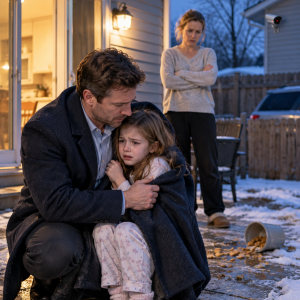
Maisie was four years old, the daughter of Claire Benson, our household manager. Claire had worked for my family for almost seven years and occasionally brought Maisie with her when preschool was closed or childcare arrangements changed. That evening Maisie had been downstairs coloring at the kitchen table while Claire helped coordinate everything happening upstairs.
She stood behind her mother wearing a pale yellow dress and holding a homemade cloth doll whose yarn hair had been sewn on unevenly.
“Maisie, honey, downstairs,” Claire said gently. “The babies need some quiet.”
Maisie did not leave.
Instead, she stared into the empty nursery with the solemn concentration children sometimes have when they are trying to understand something adults have stopped noticing.
Then she walked inside.
Claire reached for her.
“Maisie.”
But the little girl had already crossed the rug.
She stopped beside Owen’s crib.
For several seconds she did nothing.
Then she crouched.
I watched her turn her head and place one ear close to the hardwood floor near the edge of the rug.
“What are you doing?” I asked.
She lifted one finger toward me.
“Shh.”
There was something so serious about her expression that every adult in the room obeyed.
Maisie listened.
Then she moved closer to the wall, lowered herself onto her hands and knees, and peered beneath the crib.
Claire gave me an apologetic look and started toward her daughter, but Maisie suddenly backed away.
Her face had changed.
Not panic.
Not confusion.
Recognition.
She hugged the crooked little doll against her chest.
“Mr. Whitaker?”
I knelt beside her.
“What is it?”
She glanced toward the hallway where the triplets were being held.
“The babies aren’t hurting.”
I tried to keep my voice steady.
“Then why are they crying?”
Maisie pointed beneath the crib.
“They’re scared.”
Carter moved closer.
“Scared of what, sweetheart?”
Maisie did not answer him.
Instead, she pointed toward a narrow wooden air-return grille built low into the wall.
I had seen that grille every day for months.
For the first time, I noticed two tiny lights blinking somewhere behind it.
Carter knelt, removed the grille, and leaned toward the opening.
Then he stopped.
“Grant,” he said quietly, using my first name only when something required my full attention. “Nobody touch this yet.”
The Noise Behind the Wall

Several inches inside the duct sat a small black device, roughly the size of a box of playing cards. Two narrow wires ran from its back and disappeared behind the wall.
For the next few moments, everyone studied it as though staring harder might explain why it was there.
“Is it recording something?” I asked.
Carter shook his head.
“Doesn’t look like a camera.”
“A microphone?”
“I don’t think so.”
Maisie shifted beside her mother.
“It makes the tiny sound.”
Every adult turned toward her.
Claire crouched beside her daughter.
“What tiny sound?”
Maisie struggled to explain.
She pressed her lips together, thinking.
“Like Grandma’s old television when it’s turned off but not really asleep.”
Aaron Bell stepped forward.
“You can hear something from there?”
Maisie nodded.
“Only in this room.”
Aaron exchanged a look with Rebecca.
Then he moved toward the vent but did not touch the device.
“Very young children can sometimes notice frequencies adults no longer perceive clearly,” he said. “Infants can be especially sensitive to certain sounds.”
Rebecca looked toward the hallway.
“Which would explain why all three react in here.”
Carter did not wait.
“Nobody stays in the nursery until we know what this is.”
That was one instruction nobody questioned.
The triplets were carried to my bedroom at the other end of the second floor. Claire took Maisie downstairs, although Maisie objected because her doll, whom she called Patches, apparently needed to remain upstairs and “guard the baby door.”
I stood outside the nursery long after everyone else moved away.
Eight months earlier, preparing that room had felt like the most important project I had ever overseen.
I had spent my career approving multimillion-dollar buildings after reviewing plans for less than half an hour, yet I had needed three weeks to choose the nursery paint. One shade seemed too gray. Another seemed too warm. The third reminded me of a medical waiting room, although nobody else understood why.
The maple cribs had been custom-made.
My mother’s old rocking chair stood beside the window.
Above a low bookcase were three framed photographs: Owen grinning in the bath, Luke sleeping with one hand tucked beside his cheek, and Emma staring into the camera with the stern expression she seemed to have been born with.
I had spent money on air filtration, temperature monitoring, window locks, cameras, and a dozen other things meant to give me confidence.
I had confused preparation with certainty.
That night, those two ideas finally separated in my mind.
Carter returned after consulting with an electrical contractor by phone.
“We want to cut power to the nursery and the adjacent utility circuit.”
“Do it.”
The overhead lights went dark. Emergency lighting from the hallway cast a faint glow through the doorway.
The two tiny lights inside the vent disappeared.
We waited ten minutes.
Then Rebecca carried Emma back.
I followed several steps behind.
At the doorway Emma remained calm.
Rebecca stepped inside.
Nothing happened.
She crossed halfway to the crib.
Emma blinked sleepily and rubbed her cheek against Rebecca’s shoulder.
Owen came next.
Then Luke.
No sudden crying.
No stiffening.
Just three exhausted babies who had been awake far too long.
Aaron looked at me.
“Whatever that device is, I think turning it off changed the environment enough for them.”
The relief that moved through me was so immediate that I had to grip the doorframe.
For hours, I had imagined medical explanations I did not want to name.
Now Emma was yawning.
Luke was already drifting toward sleep.
Owen had discovered a button on Rebecca’s sleeve and seemed far more interested in it than in the room.
Then I asked the question everyone had been avoiding.
“Who put that thing there?”
The mood shifted again.
Carter straightened.
“I’ll trace it.”
My first instinct was familiar: lock down the property, question everyone, check every camera, every access record, every contractor file.
But then I looked into the hallway.
Claire was holding Maisie’s hand.
The caregivers were exhausted.
The babies had finally settled.
For once, I did not want my anxiety to become everyone else’s emergency.
“Quietly,” I told Carter. “No accusations. We find out what it is first.”
He studied me for a second before nodding.
“Quietly.”
A Different Kind of Protection