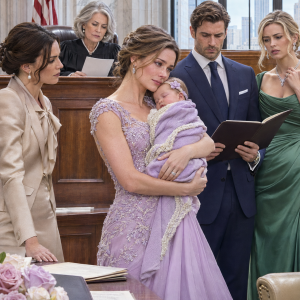
The Room Beneath the House

When the estate manager stepped quietly into the dining room and told Grant Holloway that I had been lying downstairs for nearly three hours with a badly bruised chest, an injured shoulder, and swelling that needed medical attention, my husband did not even put down his glass.
He simply glanced toward the tall windows of our home outside Greenwich, Connecticut, where evening was settling over the lawn, and said, “No doctor. Keep her downstairs until she learns to stay away from Elise.”
Across the table, Elise Marlowe raised one hand to her mouth, performing concern with the careful precision of an actress.
“Grant, please. Claire is still your wife.”
He gave a dry laugh.
“Then she should start acting like one.”
My name is Claire Whitmore, and while my husband finished dinner beneath a crystal chandelier, I was curled on the concrete floor of a storage room beneath the west wing of the house, taking shallow breaths because anything deeper sent an ache through my side.
According to Grant, I had pushed Elise down the back staircase.
What actually happened was simpler—and far more deliberate.
Elise had come into my bedroom carrying a tray of tea I had never requested. I told her I wanted to be alone. She took two slow steps backward, glanced past my shoulder toward the hallway, and then allowed herself to tumble onto the carpeted stairs at the exact moment Grant appeared around the corner.
She cried out his name before she even reached the landing.
I stared at her in disbelief.
“I didn’t touch her.”
Grant never asked what I had seen. He never checked the hallway camera. He never asked the staff whether anyone had heard an argument.
He simply called for two members of the household security team.
When one of them hesitated after seeing how badly I had been hurt during the struggle to remove me, Grant turned away.
Later, when the man warned that I might need professional care, Grant answered without looking back.
“Keep going.”
By then I understood that explanations meant nothing to a man who had already decided which version of the truth was most convenient.
Hours later, the metal door opened.
Lucas Bennett, the Holloway family’s estate manager, slipped inside carrying water, bandages, and pain relievers beneath his jacket. Lucas had worked around the family for almost ten years. He was quiet, observant, and usually careful never to place himself between Grant and his temper.
That night, he did.
He knelt beside me.
“Mrs. Holloway, I can’t call an ambulance from the property without Mr. Holloway being notified.”
I studied his face.
He looked ashamed.
But he did not look surprised.
That mattered.
“Then do something else for me.”
He leaned closer.
I told him about a small silver compass pendant hidden inside the lining of an old suitcase in the guest closet. My father had given it to me when I turned eighteen. To anyone else it looked like an ordinary keepsake.
To a handful of people from my old life, it meant something very different.
“Take it to a watch-repair shop in New Haven called Bell & Finch. Ask for Mr. Mercer. Give him the pendant and say, ‘Claire is awake. It’s time.’ Nothing more.”
Lucas went pale.
My family had once controlled Whitmore Transit & Materials, a privately held company that supplied stone, rail access, storage yards, and heavy equipment to major construction projects across the Northeast.
We were never a household name, but in certain business circles, Whitmore carried weight.
Three years earlier, five lenders withdrew major credit facilities within forty-eight hours of one another.
Projects stopped.
Suppliers demanded payment.
Longtime partners panicked.
Contracts that had seemed secure suddenly disappeared.
Within ten days, the company my grandfather had founded and my father had spent three decades expanding was falling apart.
My parents were returning from a meeting in Canada aboard a chartered aircraft when the plane went down before reaching Connecticut.
My older brother, Owen, had been listed among the passengers.
After that, everyone believed I was the last Whitmore.
Grant became almost tender during those first months. He held my hand at memorial services. He answered reporters for me. He told friends I needed quiet and time.
Then companies associated with Holloway Consolidated began acquiring former Whitmore properties.
Rail yards.
Storage facilities.
Land my father had refused to sell Grant only a year earlier.
For three years, I told myself there had to be another explanation.
That night in the basement, Elise finally gave me permission to stop lying to myself.
She came downstairs alone shortly after midnight.
She wore a pale cashmere coat and carried herself with the calm confidence of someone who believed the outcome had already been decided.
She crouched beside me.
“Do you know what’s almost sad, Claire? You still think Grant ruined your life because of me.”
I said nothing.
Her smile widened.
“Whitmore’s lenders didn’t suddenly lose confidence. We made sure they did.”
My body went still.
“Who is ‘we’?”
She leaned closer.
“And your parents’ flight was not simply bad luck.”
For a moment, even the room seemed to lose its air.
“What are you saying?”
Elise stood and brushed an invisible speck from her sleeve.
“I’m saying your family was in the way. Your brother was supposed to be on that plane too. I never understood how you ended up being the one piece left on the board.”
Then she walked out.
The lock clicked behind her.
I closed my eyes and repeated the message I had sent through Lucas.
Claire is awake.
It’s time.
Because Elise had just made the mistake arrogant people make more often than they realize.
She assumed that because I had been quiet, I had been powerless.
The Brother Who Disappeared
Lucas returned shortly before sunrise.
He opened the door only a few inches and whispered, “I delivered the pendant. Mr. Mercer asked if you were conscious. I told him yes. He said to tell you one thing.”
“What?”
“Wait.”
Two days later, Grant allowed me out of the basement.
Not because he had reconsidered what he had done, but because acquaintances had started asking why no one had seen me.
He moved me into a small room near the service corridor, canceled my credit cards, restricted my access to the family offices, and announced that Elise would now oversee household finances and most of the staff.
Then he stood in my doorway and said, “You’ll receive fifteen hundred dollars a month. Be grateful I’m not asking you to leave.”
I lowered my eyes.
That seemed to reassure him.
It was exactly the reaction he expected from a woman he believed had nowhere else to go.
That evening I found an old flip phone hidden beneath the false bottom of a sewing box.
There was one number stored in it.
I called.
A man answered on the second ring.
“Bell & Finch.”
“Mr. Mercer.”
There was silence.
Then a soft breath.
“Miss Claire. It has been three years.”
I asked the only question that mattered.
“What happened to Owen?”
His reply changed everything.
“Your brother never boarded the aircraft.”
I sat down on the edge of the bed.
Two hours before departure, Owen had received an anonymous warning. Something was wrong with the trip, the message said, and he should not board.
He removed copies of several financial documents from his briefcase, left the airport through another exit, and disappeared before anyone searching for him could react.
For three years, Owen had been tracing the collapse of our company.
He had also placed people inside Grant’s world.
Lucas Bennett was one of them.
Several days later, another piece arrived through Natalie Price, my former college roommate, who now worked as a forensic accountant for a national insurance cooperative.
Natalie had been investigating Elise.
There was almost no reliable record of anyone named Elise Marlowe before her arrival in Connecticut.
Her real name was Nora Kessler.
Years earlier, Nora had worked as an operations analyst for a private risk-consulting company repeatedly hired by Sterling Holloway.
Sterling was Grant’s uncle.
The two men had been fighting for control of Holloway Consolidated for more than a decade.
Suddenly, everything about Nora made sense.
She had appeared in Grant’s life after a suspicious highway collision outside Boston. According to the story Grant loved telling, she had happened to be nearby and had helped him until emergency crews arrived.
Within months, she became someone he trusted.
Then someone he consulted.
Eventually, she gained access to transfers, loan structures, acquisitions, board documents, and voting agreements.
Grant believed Nora had rescued him.
In reality, Sterling had placed her beside him.
But Nora had made another mistake.
She had investigated Claire Holloway.
She had never bothered to investigate Claire Whitmore thoroughly enough.
Five years earlier, before my family company collapsed, I had begun making private investments through a legal holding structure called North Lantern.
It started modestly, using money my grandmother had left me and income from several small industrial leases.
Then the investments grew.
I kept my name out of public-facing records because I wanted something that belonged entirely to me—not to my father, not to my husband, and not to either family reputation.
By the time Grant reduced me to a monthly allowance, North Lantern controlled assets worth hundreds of millions of dollars.
And for months, it had been quietly buying shares in Holloway Consolidated through properly registered investment entities.
Grant thought he had made me dependent.
He had no idea I was becoming one of the shareholders he would soon need most.
I met Owen four days later in a small diner outside Providence.
For a moment I did not recognize him.
He was thinner, his hair shorter, his face older in a way that had little to do with age.
Then he smiled.
I knew him immediately.
He crossed the room and embraced me carefully.
Neither of us spoke for a while.
Finally, he placed a small encrypted drive between our coffee cups.
“It’s all here.”
Owen had traced payments from Sterling’s network through consulting firms, vendors, and contractors connected to the charter company’s maintenance chain.
Then he told me the part I was not prepared to hear.
“Grant didn’t know what Sterling intended to do with the flight.”
A foolish sense of relief moved through me.