PART 1: MONEY ON THE MARBLE FLOOR
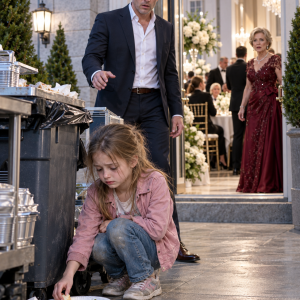
The afternoon my husband threw lunch money at my feet, our three-year-old daughter was sleeping against my shoulder inside the marble lobby of the Whitmore Crown Hotel in Seattle.
Daniel Royce stood beside a sculpted fountain wearing the charcoal suit I had purchased for his promotion dinner. His arm remained linked with Vanessa Cole, the strategic consultant he had recruited four months earlier to advise Whitmore Industries about governance, succession planning, and asset protection.
Vanessa’s professional title had once reassured me, although her champagne dress and possessive hand resting against my husband’s chest explained their relationship more honestly.
Daniel had canceled lunch with me three times that week, claiming an emergency restructuring meeting required his attention. When I arrived unexpectedly with our daughter, Sophie, neither Daniel nor Vanessa appeared particularly surprised.
“Evelyn, you should have called before bringing Sophie into a business meeting.”
“I called twice, although apparently Vanessa’s company required your complete attention.”
Vanessa tightened her hold while Daniel glanced toward the hotel guests gathering near the elevators. He seemed less embarrassed by his affair than irritated that I had interrupted its performance.
“Please take Sophie home before you make this situation unnecessarily dramatic.”
“The dramatic part occurred when my husband brought his mistress into a hotel belonging to my family.”
Vanessa smiled with the practiced sympathy of someone who had rehearsed my humiliation.
“Daniel told me your grief has made ordinary circumstances difficult for you to interpret.”
My father, Harrison Whitmore, had died two years earlier after building Whitmore Industries across hotels, commercial real estate, logistics centers, and investment properties. Since his death, Daniel had repeatedly described my sadness as instability whenever I questioned his growing authority inside the company.
He had encouraged me to withdraw from the board, reduce my responsibilities, and concentrate upon motherhood. Because I trusted the man I had married eight years earlier, I confused his isolation strategy with compassionate support.
Daniel removed several folded bills from his wallet and dropped them onto the polished floor between us.
“Take this money, buy yourself some lunch, and stop embarrassing everyone who actually has responsibilities.”
Several employees immediately looked away, while Vanessa released a delighted laugh she attempted to disguise behind one manicured hand.
Sophie stirred against my shoulder, forcing me to control every expression crossing my face. Daniel watched closely, almost as though he expected shouting, threats, or an impulsive strike that nearby security cameras would preserve.
Instead, I slowly crouched, gathered the scattered bills, and placed them inside my handbag.
His satisfied smile suggested he believed I had accepted my proper position.
Then I removed the black satellite telephone my father had given me shortly before his final hospitalization. A silver hawk had been engraved above its protected keypad, while only three secured numbers existed inside its directory.
Daniel’s confidence vanished when he recognized the device.
“Evelyn, whatever you believe happened here does not justify using that telephone.”
“Your fear suggests this telephone concerns considerably more than a marital disagreement.”
I called Martin Caldwell, the sixty-two-year-old director of the Whitmore Family Office, who had served my father for twenty-seven years.
“Martin, authenticate the Night Hawk protocol and suspend every authority connected with Daniel Royce.”
The hotel’s secured elevators chimed almost immediately. Daniel’s executive credentials disappeared from his telephone, while his access to corporate accounts, private offices, financial platforms, and management systems was automatically revoked.
Vanessa stepped away from him for the first time.
Martin’s voice remained steady through the encrypted connection.
“The suspension has been completed, although activating Night Hawk has opened a sealed succession file your father instructed us to release under these circumstances.”
“What circumstances did he specify?”
“Revocation of spousal authority, emergency intervention in governance, or a credible threat involving Sophie’s custody.”
Daniel moved toward me, although hotel security intercepted him before he could touch my arm.
“Do not read that file until we discuss this privately.”
His desperation answered questions I had not yet understood enough to ask.
“What is the file called, Martin?”
A brief silence followed before Martin answered carefully.
“Your father named the protected file WREN, and its designated beneficiary is Sophie Royce.”
PART 2: THE INHERITANCE NOBODY COULD SELL
Martin met Sophie and me inside my father’s private residence on the hotel’s forty-first floor. Reinforced glass, biometric locks, independent communications, and a concealed security station made the apartment resemble an elegant fortress.
After placing Sophie beneath a quilt in the familiar guest room, I entered the study where Martin waited beside a leather portfolio.
The first page carried my father’s signature beneath a single declaration:
WREN BENEFICIARY: SOPHIE ROYCE.
Martin explained that the public succession plan transferred substantial ownership of Whitmore Industries to me, but my father had placed the founder’s voting units inside an irrevocable trust. Those units could prevent the sale, mortgage, or dissolution of the company’s essential assets.
Until Sophie reached adulthood, independent trustees would administer Wren and preserve the business for her future. However, one provision allowed a legally recognized guardian to request temporary representation during certain corporate votes.
“If something happened to me, Daniel could petition to represent Sophie’s interests.”
“He could also petition if a court declared you incapacitated or removed your custodial rights.”
The room seemed to contract around me as recent memories acquired frightening meanings. Daniel had repeatedly mentioned my forgetfulness, photographed prescription medication, and recorded occasions when grief overwhelmed me after my father’s death.
Martin opened another section containing communications discovered during my father’s private investigation. Daniel and Vanessa had worked together at a consulting firm seven years earlier, although neither disclosed that relationship when Vanessa received access to Whitmore’s succession materials.
My father had written one observation beside their correspondence: Daniel is studying this family rather than serving it.
“Why did my father never warn me directly?”
“He intended to explain everything, but his illness progressed before he could complete that conversation.”
Another collection had been automatically attached when Night Hawk revoked Daniel’s credentials. The documents originated from an outside family-law practice and described a proposed emergency custody petition.
Daniel’s draft affidavit characterized me as emotionally unstable, dependent upon medication, unreliable with schedules, and overwhelmed by corporate duties and motherhood. Every ordinary moment of human vulnerability had been carefully stripped from its context and preserved as evidence.
He described the afternoon I missed Sophie’s preschool pickup without mentioning that he had changed the schedule and sent the revision toward an abandoned email address. He included a photograph of me crying after my father’s memorial and transformed appropriate psychiatric treatment into proof of continuing emotional incapacity.
The earliest version had been prepared eleven weeks earlier.
“He began constructing a custody case before I discovered Vanessa.”
“That conclusion is supported by the document history and several related communications.”
Martin displayed messages in which Daniel instructed Vanessa to intensify discussions about my grief whenever I resisted leaving the board. Another message advised her never to mention Wren electronically because custody representation would provide access later.
My husband had not required my death, because a living woman labeled unstable would attract less suspicion and provide greater convenience.
I remembered Daniel humiliating me downstairs while watching for an emotional explosion. The hotel, the audience, Vanessa’s laughter, and the money had never represented carelessness.
They had created a stage.
“He expected me to strike one of them while the cameras recorded everything.”
Martin’s expression hardened as he understood the same possibility.
“That recording could have supported an immediate petition concerning Sophie.”
I looked through the study window toward the city my father’s company had helped reshape. Daniel believed grief had made me incapable of protecting what remained, yet he had mistaken exhaustion for surrender.
“Preserve every camera angle from thirty minutes before my arrival, because I want proof showing whether they waited for me.”