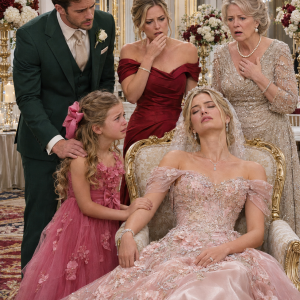
Part 1: The Empty Chair at the Hawthorne Table
“Serve everyone else first, because women who have not learned gratitude do not sit at this table.”
Evelyn Hawthorne delivered the order with the practiced calm of a woman who had spent decades disguising humiliation as tradition. Before I could lower myself into the chair beside my husband, she pulled it backward with one sharp movement, nearly causing the serving platter in my hands to slide onto the polished walnut floor.
My name is Claire Rowan, and at thirty-six, I was the founder and chief executive of Rowan Strategies, a crisis-communications firm headquartered in downtown Chicago. That morning, I had awakened before sunrise to organize a memorial dinner honoring my late father-in-law, Henry Hawthorne, whose portrait occupied a prominent place above the fireplace in the family’s historic mansion near Lake Forest.
I had selected the flowers, approved the menu, coordinated the wine delivery, and spent most of the afternoon helping Mrs. Bell, the household cook, prepare roasted chicken, herb potatoes, glazed carrots, mushroom soup, and Henry’s favorite bourbon bread pudding.
By seven o’clock, the dining room was filled with relatives who had contributed nothing except criticism. My sister-in-law, Madison, arrived wearing a designer coat purchased with a card attached to my account. My husband’s younger brother, Caleb, opened a beer before anyone finished saying grace. My husband, Evan, sat beside his mother and watched her rearrange the place settings I had spent an hour preparing.
When I finally approached the last empty chair, Evelyn pulled it away.
“The salad plates are still in the kitchen, the wine has not been poured, and the bread basket is nearly empty,” she said. “A proper daughter-in-law understands that service comes before comfort.”
I turned toward Evan, expecting embarrassment, anger, or at least a single sentence defending the woman he had promised to honor.
He lowered his eyes and moved a piece of chicken around his plate.
“Please do not create a scene, Claire,” he murmured. “Mom is grieving, and you know how particular she becomes during family occasions.”
Madison laughed and raised the phone I had bought her the previous Christmas.
“This is unbelievable,” she said while recording. “Chicago’s famous public-relations queen cannot even earn a chair in her own dining room.”
Caleb continued eating without looking up. Evelyn folded her hands with satisfaction, believing the silence around the table proved her authority.
Something inside me did not break dramatically. It simply stopped negotiating.
For four years, I had paid bills, solved emergencies, and absorbed insults because Evan repeatedly assured me that his family would eventually appreciate everything I did. I had covered Evelyn’s property taxes, financed Madison’s boutique, paid Caleb’s legal fees after a reckless-driving arrest, and refinanced part of the mansion after discovering the Hawthorne estate carried more debt than anyone admitted.
I had called those payments generosity because acknowledging the truth would have forced me to confront the weakness at the center of my marriage.
That evening, standing against the wall while everyone ate the dinner I had funded and prepared, I finally understood that the Hawthornes did not consider my generosity an expression of love. They considered it proof that I had accepted a permanent obligation to serve them.
I placed the salad plates on the table, poured the wine, and served myself a small portion of food. Then I stood beside the sideboard and ate without displaying anger.
Evelyn watched me suspiciously.
“You are unusually quiet.”
“You were right about one thing,” I replied. “Tonight has reminded me exactly where I belong.”
She smiled, believing she had won.
At ten-thirty, after the guests departed and the kitchen had been cleaned, I carried one suitcase, my laptop, several legal folders, and my grandmother’s jewelry box to my car. Evan had gone upstairs without asking where I intended to sleep.
I drove directly to my office in the West Loop.
My chief operating officer, Naomi Reyes, arrived twenty minutes after receiving my message. Together, we reviewed four years of statements, vendor records, credit-card charges, and automatic transfers connected to the Hawthorne family.
By three in the morning, the total reached $412,680.
That figure included Evelyn’s annual wellness membership, Madison’s boutique rent, Caleb’s truck payments, Evan’s country-club fees, repairs to the Lake Forest mansion, several luxury vacations, and dozens of expenses labeled as temporary family emergencies.
The mansion itself belonged to me.
Evelyn had lost it during foreclosure proceedings two years before my marriage, and I had purchased it through a private holding company to prevent the family from being displaced. Evan and I had also signed a prenuptial agreement establishing that my company, real estate, investments, and preexisting assets remained separate property.
At four-fifteen, I called the bank’s emergency services department.
I canceled every secondary card, terminated automatic transfers, froze discretionary accounts, and removed payment authorization from every Hawthorne expense that carried my name.
Then I turned off my phone, lay down on the sofa in my office, and slept more peacefully than I had during the previous year.
Part 2: The Morning Their Privileges Disappeared
At nine-thirty the following morning, Madison attempted to purchase a six-thousand-dollar handbag on Michigan Avenue. Her card was declined three times while two sales associates watched.
At nearly the same moment, Evelyn arrived at a medical spa in Highland Park and discovered that her prepaid cosmetic-treatment package had been canceled. She reportedly demanded to speak with the owner before learning that the agreement had always been billed directly to Rowan Strategies.
Caleb received a call from the finance company informing him that his truck payment was overdue and repossession proceedings would begin unless he transferred the balance immediately.
By eleven o’clock, Evan entered my office without an appointment. His face was red, his tie was crooked, and he looked more offended than frightened.
“What have you done?” he demanded. “My family has been humiliated all morning.”
I pushed the financial summary across my desk.
“Four hundred twelve thousand, six hundred eighty dollars,” I said. “That is what your family has taken from me while explaining that I should be grateful for their acceptance.”
Evan barely glanced at the number.
“We are married. Married people support one another’s families.”
“Support is voluntary, transparent, and respected. What happened here was entitlement financed by my silence.”
He began pacing.
“You cannot punish everyone because Mom made one insensitive comment during an emotional dinner.”
“Your mother removed my chair. Your sister recorded me. Your brother kept eating, and you asked me not to embarrass anyone.”
Evan finally attempted an apology, but his next sentence revealed his actual priority.
“Can you reactivate Caleb’s truck payment for one month? He needs transportation while we sort this out.”
I pressed the intercom and asked security to escort him downstairs.
Before he left, I informed him that I would be staying in a condominium I owned near the Chicago River and that all future discussions concerning our marriage would occur through my attorney.
That afternoon, Madison arrived demanding the return of what she called her personal card. When Naomi explained that the account legally belonged to Rowan Strategies, Madison swept a glass paperweight from the reception desk and shouted that I was destroying the family.
Building security removed her before she reached my office.
The following evening, I invited Mrs. Bell to meet me at the riverfront condominium. She had worked for Evelyn for nearly fourteen years, accepting low wages, no health benefits, and constant criticism because she believed women her age had few alternatives.
After preparing soup and bread, she served my bowl, then stepped backward toward the kitchen.
I pulled out the chair opposite mine.
“Please sit with me, Mrs. Bell. Nobody eats standing in this home.”
She stared at the chair before slowly lowering herself into it. Her eyes filled with tears.
“Mrs. Hawthorne always said staff should remain available until the family finished.”
“Respect does not disappear because someone receives a paycheck.”
That quiet meal confirmed what I had already understood. Evelyn’s rules were never about tradition. They were designed to remind women, employees, and anyone financially vulnerable that dignity was something she could distribute or withdraw.
The extended Hawthorne family maintained a private messaging group with more than sixty members. By the next morning, it had become a courtroom filled with accusations.
Relatives called me arrogant, disloyal, vindictive, and ungrateful. Evelyn claimed I had abandoned Evan for another man. Madison wrote that successful women eventually become cold because money replaces feminine loyalty.
I uploaded one document containing bank statements, invoices, canceled checks, and expense summaries. Beneath it, I wrote a single message.