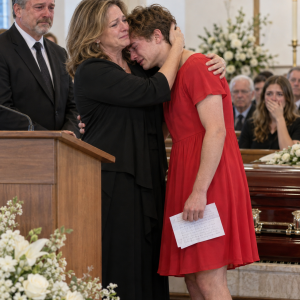
Part 1 – The Signature Beneath The Mourning Flowers
Less than twenty-four hours after her father’s memorial service, Caroline Ashford learned that grief had made her vulnerable to more than sorrow.
She stood inside the formal drawing room of the family estate in Westchester County, still wearing the simple black dress she had chosen for the funeral. White lilies and condolence arrangements crowded every table, filling the room with a sweetness so heavy that breathing felt difficult.
Across from her, her husband, Preston Caldwell, dropped a leather portfolio onto the marble table.
“Your father died believing you would inherit everything, yet you signed control of Ashford Consolidated over to me before the flowers from his funeral had even begun to wilt.”
Caroline opened the portfolio and stared at the documents. Her signature appeared beneath a transfer agreement assigning sixty-two percent of her voting shares to a trust Preston controlled. A separate page contained a petition for divorce and a waiver limiting her rights to company property.
She remembered signing papers two weeks earlier while recovering from a severe respiratory infection. Preston had brought warm tea into the bedroom, described the documents as emergency banking authorizations, and placed colored tabs beside each signature line.
“You lied to me.”
Preston smiled without affection.
“I completed a transaction you were too sheltered to understand. Ashford Consolidated has enormous liabilities, and your father concealed them because he wanted everyone to keep worshipping him.”
His mother, Margaret Caldwell, stood near the fireplace wearing a crimson evening dress instead of mourning clothes. Around her neck rested Caroline’s grandmother’s pearl necklace, which Margaret had borrowed for the memorial and apparently decided to keep.
“Preston saved the company from an incompetent heiress,” Margaret said. “You should feel relieved that someone capable has finally taken responsibility.”
Caroline turned toward her husband.
“My father hired you when no major firm would take your calls. He promoted you, brought you into our home, and defended you when the board questioned your judgment.”
“He treated me like an ambitious employee who should remain grateful for scraps,” Preston replied. “Marrying you was the price of reaching the position I deserved.”
The words landed harder than the documents.
Caroline slapped him.
Margaret reacted instantly, grabbing Caroline’s hair and shoving her toward the edge of the table. Caroline struck her forehead against the marble and fell to one knee.
Preston did not stop his mother. He summoned two private security guards instead.
“Remove her from the property,” he ordered. “Take her phone, cards, and keys. Nothing in this house belongs to her anymore.”
Caroline struggled against their grip.
“My father purchased this estate before I was born.”
Preston poured himself champagne.
“Your father died when his car went over the Hudson Valley ridge. Dead men do not own houses.”
The guards dragged Caroline through the entrance hall and left her outside the iron gates without shoes, a coat, or money. Snow mixed with freezing rain, soaking her dress within minutes.
From an upper balcony, Preston raised his glass.
“Let us see how long an Ashford princess survives after losing her last name and fortune.”
The gates closed.
Caroline walked along the empty road while blood from the cut on her forehead mixed with melting snow. With every step, one thought became clearer.
Preston had prepared the transfer documents before her father’s accident.
If he had planned the theft before Harrison Ashford died, then perhaps the accident had never been accidental.
Part 2 – The Driver Who Kept The Old Telephone
Caroline walked nearly five miles before a delivery driver stopped and gave her a ride to the commuter station. From there, she traveled toward a small apartment in Yonkers belonging to Samuel Reed, her father’s former driver and security aide.
Samuel had served Harrison for twenty-four years before retiring. When he opened the door and saw Caroline barefoot and trembling, he asked no unnecessary questions. He wrapped her in a blanket, cleaned the cut above her eyebrow, and placed hot soup in front of her.
After hearing what Preston had done, Samuel struck the table with his palm.
“Your father had been investigating him for months. Five major development projects contained false invoices, payments to shell vendors, and materials that were billed but never delivered.”
Caroline gripped the blanket around her shoulders.
“Why did Dad never tell me?”
“Because Preston had already isolated you from most financial decisions. Your father needed evidence strong enough that Preston could not explain it away as family hostility.”
Samuel explained that the evening before Harrison’s fatal drive, he saw Preston’s personal assistant near the Ashford company garage carrying a tool case. Samuel had inspected the brakes less than forty-eight hours earlier and found no defects.
The official report claimed Harrison’s sedan lost control on a mountain road and burned after falling down a steep ravine. The remains were identified through property found inside the wreckage because the fire prevented visual confirmation.
Caroline stared at Samuel.
“You believe Preston arranged the crash.”
Before Samuel could answer, a metal box inside the closet began ringing.
He removed an old satellite phone that Harrison had insisted he keep for emergencies. The display showed an encrypted contact associated with Ashford security.
The message was prerecorded.
Harrison’s voice filled the apartment.
“Caroline, if you hear this recording, then Preston has moved against you after my reported death. Do not speak with the press, do not sign anything else, and do not trust documents bearing your signature until an independent expert reviews them. Inside the bronze eagle I gave Samuel is a key. Take it to attorney Eleanor Bishop. She knows the next step.”
The recording ended.
Caroline pressed both hands against her mouth.
Samuel retrieved the bronze eagle from a shelf and removed the felt base. Inside lay a small key and an encrypted storage device.
Attorney Eleanor Bishop arranged a meeting at a private records facility beneath an old bookstore in Manhattan. She had represented the Ashford family for more than three decades and greeted Caroline without visible surprise.
The secure room contained financial maps, corporate ownership charts, bank records, and surveillance images. At the center of the main screen appeared the name Meridian Reserve.
Eleanor explained that Harrison had transferred the company’s patents, profitable land holdings, and strongest contracts into a protected holding structure months earlier. Preston had obtained voting control over a public corporation burdened by obligations, while Meridian Reserve controlled the assets required to keep it alive.
“He believes he inherited an empire,” Eleanor said. “In reality, he accepted personal guarantees attached to a failing shell.”
Caroline looked across the room.
A tall man with silver hair stood near the darkened windows.
Her knees nearly failed when he turned.
Harrison Ashford walked toward her.
“Forgive me, sweetheart,” he said. “I needed Preston to believe he had killed me before he would expose everything he had built.”
Part 3 – The Father Who Returned From The Dead

Caroline crossed the room and struck her father’s chest before collapsing into his arms.
“You let me bury you. You let me stand beside an empty urn while he took everything from me.”
Harrison held her without defending himself until her anger broke into exhausted sobbing.
“The operation was coordinated with federal investigators,” he explained when she could finally listen. “We confirmed that Preston’s people intended to disable the brakes. The vehicle was replaced, and the decoy car was remotely guided into the ravine after I entered protective custody.”
“Why did nobody warn me?”
Pain entered Harrison’s expression.
“Because Preston watches your reactions more closely than anyone. If you had known I was alive, he would have recognized it before the funeral ended. The investigators needed him to move the stolen money, contact his accomplices, and execute the documents he had prepared.”
“You used me as bait.”
“Yes,” Harrison answered quietly. “That decision may be the greatest failure of my life, even if it helps convict him.”