The Morning Everything Exchange

The morning my twins were born, I still did not know whether I would ever get to carry them home.
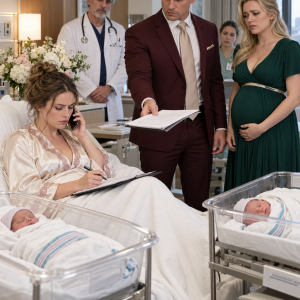
Henry and Elise arrived at twenty-nine weeks in a bright operating room at Northbridge Children’s Center in Minneapolis, far earlier than anyone had planned, so tiny that the first glimpse of them left me afraid even to breathe in their direction. They did not enter the world with the strong cries I had imagined during all those months when I lay awake picturing their faces. Henry made one thin, scratchy sound before a nurse carried him toward a warming station, while Elise disappeared almost immediately behind a cluster of doctors and respiratory specialists, and all I saw before the room blurred was one miniature foot beneath a white blanket.
After that came fragments: ceiling lights, clipped medical instructions, the pressure of an oxygen mask, hands moving quickly, and a deep physical exhaustion that seemed to pull me away from everything I loved.
When I opened my eyes again, nearly two days had passed.
A nurse explained that there had been serious complications and that I had needed additional care. She said my twins were in the neonatal intensive care unit. She said the medical team was watching them closely. She said I needed to rest.
What nobody told me, because nobody in that hospital could have known, was that while my body was recovering and my children were learning how to stay in this world one hour at a time, my marriage had already reached its end.
My husband, Wesley Tate, had visited once while I was unconscious.
A young nurse named April told me because I kept asking whether he had been there.
She hesitated beside my bed, adjusting the edge of my blanket even though it did not need adjusting.
“He came by for a few minutes,” she finally said. “He asked whether you were expected to wake up that day. Then he left.”
Even then, I defended him.
That had become one of my strongest habits during our four-year marriage.
I told myself Wesley was frightened. I told myself some people could not handle intensive care units, or premature babies, or the sight of a spouse surrounded by medical equipment. I reminded myself that fear made people strange, that everyone carried worry differently, and that perhaps he was somewhere alone trying to hold himself together.
It was the last generous explanation I ever invented for him.
On the third morning, my doctor allowed me to visit the neonatal floor. April wrapped a pale blanket over my knees and pushed my wheelchair through a secure corridor that smelled faintly of disinfectant, paper coffee cups, and freshly cleaned plastic. The unit was quiet in a way ordinary hospital floors were not. Nobody slammed doors. Nobody laughed loudly. Every movement seemed measured because every family there understood how fragile a single minute could feel.
Henry’s incubator stood to the left.
Elise’s was beside it.
Their names looked enormous on the small cards attached to the machines.
Henry lay with one hand resting open against the sheet, his fingers so fine they seemed drawn in pencil. Elise wore a soft breathing support secured gently around her head, and every rise of her chest was so subtle that I found myself counting.
One.
Two.
Three.
I rolled closer and placed my palm against the clear wall beside her.
“I’m here, sweetheart,” I whispered. “Mom’s right here.”
A monitor continued its steady rhythm.
I held on to that sound.
At 10:14 a.m., my phone vibrated.
The first alert came from our bank.
Our primary joint account had been emptied.
I stared at the screen, certain I had misunderstood the notification. Then another arrived.
My card had been canceled.
A third followed.
My online access had been changed.
For several seconds, I could not make sense of what I was seeing. The numbers on the screen felt unreal, as though they belonged to someone else’s life. Then a cold clarity settled over me, and I understood that the sequence was not accidental.
April looked up from the nursing station.
“Mrs. Mercer, are you feeling okay?”
I had opened my mouth to say yes when the secure doors at the far end of the hall opened.
Wesley walked in.
He was not alone.
The woman beside him was Mallory Pierce.
I knew enough about Mallory to understand exactly what her presence meant. For months, her name had appeared on Wesley’s phone first as a business contact, then as a late-night message, then as part of the widening distance in my husband’s face whenever I entered a room. Wesley worked as a commercial real-estate consultant, and Mallory had been introduced to me once at a holiday reception as a regional development executive. She had shaken my hand, complimented my earrings, and asked when the twins were due.
Now she was clearly expecting a baby herself.
But that was not what stopped me.
She was wearing my coat.
It was a dove-gray cashmere coat Wesley had given me after we learned I was carrying twins. He had insisted on having it tailored. He had stood behind me in our bedroom, smiling into the mirror, and told me I deserved something beautiful during a pregnancy that had already become difficult.
Inside the collar, stitched in tiny silver thread, were the initials H and E.
Henry and Elise.
Mallory touched the collar as she approached, and I watched her fingers brush the embroidery.
Wesley did not look at our children.
That was the part I would remember most clearly.
He did not glance toward the incubators. He did not ask which twin had gained an ounce. He did not ask whether Elise still needed extra breathing support or whether Henry had tolerated his feeding. He did not ask whether I could stand without assistance.
Instead, he stopped in front of my wheelchair, removed a black leather folder from beneath his arm, and placed it on my lap.
“Sign it.”
The folder landed with a small, flat sound.
April went still near the entrance.
I opened it with hands that were weak from surgery and exhaustion.
The first document was a divorce petition.
The pages that followed included a proposed settlement, property claims, account summaries, and prepared signature lines. Wesley wanted the condominium lease assigned entirely to him. The vehicles remained under his control. The furnishings in our home were listed as part of property he claimed to manage, including pieces I had bought years before meeting him. His investments were carefully protected through language his attorney had obviously spent time constructing.
Then I reached the page concerning the twins.
Elise’s name was misspelled.
Not a tiny typographical error.
A careless version of the name we had chosen together after weeks of conversation.
I looked up.
“What did you do?”
Wesley’s mouth curved slightly.
“What I had to do.”
Mallory shifted beside him.
“Julia, please don’t make this harder than it needs to be.”
I looked at the coat before I looked at her.
“You both made that choice before you walked in here wearing pieces of my life.”
Her expression tightened.
Wesley leaned closer.
“I closed the joint accounts this morning. Your cards are canceled. The condo agreement is under my name, and let’s be realistic. You’re not going to manage two medically fragile infants on your own.”
April’s jaw tightened.
I saw it reflected in the glass.
I raised one finger slightly, asking her not to interrupt.
Not because Wesley deserved courtesy.
Because I needed to hear all of it.
There are moments when the final truth about a person must be allowed to finish speaking. Otherwise, years later, you may still find yourself softening what happened, editing the edges, telling yourself perhaps it was not quite as clear as you remember.
Wesley looked toward the folder.
“You’ll figure something out for yourself and the babies.”
A monitor beside Henry changed rhythm for two brief beats before settling again.
My entire body reacted.
I turned toward my son, breathing slowly until the numbers steadied. Behind that clear wall, Henry moved one hand.
Wesley mistook my silence for surrender.
He had always done that.
For years, he had mistaken privacy for powerlessness.
The Life He Never Bothered to Understand

I rarely spoke about my family’s finances.
My mother had raised me to believe that money was a responsibility, not a personality. I never introduced myself with my grandfather’s surname, never mentioned family holdings at dinners, and never corrected people who assumed the modest townhouse I kept before marriage represented everything I owned.
Wesley knew I had inherited a trust.
He assumed it was small.
I let him assume.
My grandfather, Arthur Bellamy, had warned me early in the relationship. Arthur had spent forty years building a regional network of children’s hospitals, rehabilitation centers, and community clinics across the Midwest. He was not theatrical about wealth. He drove the same dark sedan for nearly a decade, remembered nurses by name, and believed the fastest way to embarrass yourself was to make another person feel small.
But he understood people.
One afternoon, long before my wedding, he noticed how frequently Wesley asked questions about my accounts.
Arthur set down his coffee and said, “Don’t hand someone the complete map of your life until you know what he would do with the keys.”
I had laughed.
“Grandpa, Wesley isn’t like that.”
Arthur had not argued.
He simply looked at me with the patient sadness of a man who knew experience could not always be transferred from one generation to another.
“People become very honest when they believe you have no way to answer them.”
Sitting beside my premature children with a divorce folder across my knees, I finally understood him.
Wesley placed a pen on top of the documents.
“Sign, Julia. Let’s finish this.”
Everything hurt. Sitting upright hurt. Taking a full breath hurt. The sight of Mallory wearing a coat embroidered with my children’s initials hurt in a way I could not explain without sounding foolish.
But the deepest ache came from imagining Henry and Elise years from now asking whether their father had stayed close during their first uncertain days, and knowing I would someday have to decide between protecting their hearts and telling them the truth.
I picked up the pen.
Then I began reading.
Wesley sighed.
“You don’t need to go through every page. My attorney reviewed it.”
I looked at him.
“Your attorney isn’t my attorney.”
For the first time, something in his expression changed.
I kept reading.
The agreement was not merely unfair. It was sloppy. Dates did not match. A paragraph suggested I had voluntarily stepped away from employment, even though I was the fundraising director for a Minneapolis arts foundation and had taken medical leave because of a high-risk pregnancy. Another section treated Wesley’s absence from the children as though it were a scheduling preference.
I lifted my phone and photographed a page.
His hand moved toward me.
“What are you doing?”
“Keeping a record.”
“Don’t be ridiculous.”
“You brought legal documents into a neonatal unit. I’m treating them like legal documents.”
Mallory gave a small laugh.
“Pictures aren’t going to rescue you.”
Perhaps they expected me to scream.
Perhaps they had imagined I would beg Wesley not to leave. Maybe Mallory had pictured herself standing calmly beside him while nurses tried to comfort the abandoned wife in the wheelchair.
But somewhere between waking after surgery and placing my hand against Elise’s incubator, I had stopped asking to be chosen.
I signed the first page.
Wesley exhaled.
I signed the second.
Mallory straightened.
I signed the third.
April looked down.
With every stroke of the pen, my mind grew clearer. I was not agreeing that Wesley was right about me. I was creating a record of exactly what he had placed before me, exactly where he had done it, and exactly who had witnessed the pressure surrounding those signatures.
When I finished, I closed the folder.
Wesley took it with visible satisfaction.
“That was easier than I expected.”
I met his eyes.
“Things often look easy when you don’t understand what you’re looking at.”
His smile faded.
Mallory stepped closer, and the sweet scent of her perfume seemed absurdly strong in that careful hallway.
“Please don’t start unnecessary drama. Stress isn’t good for the babies.”
I looked at her for a long moment. I deliberately did not look at the child she was expecting. That baby had nothing to do with the choices made by the adults in front of me.
“Then perhaps you shouldn’t have come to the neonatal floor wearing a coat with my children’s initials inside it.”
Her hand flew to the collar.
For the first time, she seemed to remember that possession and ownership were not the same thing.
Wesley tucked the folder under his arm.
“Call a shelter. Call a friend. Borrow money if anyone is willing. I honestly don’t know who would come for you.”
That sentence stayed between us.
I picked up my phone.
Wesley smiled.
“What now? The bank? You don’t have access anymore.”
“No.”
I found a number I had memorized years earlier.
It was not saved under Grandpa.
There was no photograph attached to it.
It was a private line my family used only when something could not wait.
“I’m calling Arthur Bellamy.”
Wesley’s expression changed so quickly that Mallory noticed.
“Who is that?” she asked.
He did not answer.
One Phone Call

Arthur answered on the first ring.
“Julia.”
Hearing his voice nearly broke through the control I had been holding together since waking in the hospital.
“Grandpa, I’m at Northbridge Children’s Center.”
A pause followed.
Not an empty one.
“The twins?”
“They’re here. They’re tiny. They’re holding on.”
“And you?”
I looked directly at Wesley.
“So am I.”
Arthur understood.
“Tell me what you need.”
“I need you to come upstairs. And bring the hospital’s head of security.”
Wesley gave a dismissive laugh.
“Julia, hang up.”
Arthur heard him.
His voice became quieter.
“Is that Wesley?”
“Yes.”
“Put me on speaker.”
I did.
April gently closed the inner door leading toward the infants so our conversation would remain in the family corridor, then stayed beside my wheelchair.
Arthur spoke first.
“Wesley, do not alter or remove another document.”
Wesley blinked.
“I don’t know who you think you are, but this is a private family issue.”
Arthur did not raise his voice.
“It stopped being private when you brought financial pressure and divorce papers into my hospital while my granddaughter was recovering from surgery and my great-grandchildren were receiving intensive care.”
Mallory went pale.
Wesley looked toward the discreet Northbridge emblem on the wall. Then he looked at the controlled-access doors. Then at April’s badge.
I could almost watch the pieces connect.
Northbridge Children’s Center.
Bellamy Health Partnership.
Arthur Bellamy.
The family history I had never used as a social introduction.
The inheritance Wesley had dismissed as a modest trust.
The network whose facilities occupied half a dozen cities across the Midwest.
Mallory whispered, “Wesley, what is he talking about?”
For once, Wesley had no prepared explanation.
At the far end of the corridor, a secure door opened.
Two hospital security officers appeared with visible identification badges. Behind them walked the floor administrator, a composed woman carrying a tablet.
Nobody hurried.
That somehow made the moment more serious.
The administrator approached me first.
“Mrs. Mercer, are you asking us to restrict their access to this floor?”
The question was gentle.
She was not asking whether I wanted revenge.
She was asking whether I wanted protection.
I looked at Henry.
Then Elise.
Then the gray coat on Mallory’s shoulders.
“Yes,” I said. “I am.”
Wesley lifted one hand.
“This is absurd. I’m her husband.”
The administrator glanced at the folder.
“You’ve just presented documents stating that you are seeking to end the marriage. You have also acknowledged restricting a recovering patient’s access to shared financial resources while inside this facility.”
“That has nothing to do with the hospital.”
Arthur’s voice came from my phone.
“Anything that affects the stability and safety of a neonatal family under our care concerns this hospital.”
One officer stepped toward Wesley.
“Sir, I’ll need your visitor badge.”
Wesley moved back half a step.
Small.
Almost nothing.
But everyone saw it.
Mallory began removing my coat. One button caught near the collar, and the fabric shook in her hands. April noticed the stitched initials.
H and E.
She looked at me.
Her eyes said enough.
Wesley tried to regain control.
“Julia, tell them to stop. This is going to look bad for everyone.”
I almost laughed at the word everyone.
Some people only discover concern for the group when they are no longer controlling it.
“No.”
One word.
That was all.
Then Wesley finally looked toward the incubators.
For the first time since entering the corridor.
“They’re my children too.”
I stood too quickly.
Pain pulled through my abdomen, and April caught my elbow, but I remained upright.
“Don’t use them now.”
My voice was steady.
“You didn’t look at them when you came in. You didn’t ask whether they were breathing more easily today. You didn’t ask what they weighed this morning. You misspelled Elise’s name in your own paperwork. Don’t suddenly remember you’re their father because you finally understand who their great-grandfather is.”
The hallway became completely still.
The Man Who Knew Their Names
Arthur arrived a few minutes later.
He did not enter like the owner of a hospital network.
He never entered anywhere that way.
He wore a dark navy jacket, leaned lightly on a polished cane, and carried the exhausted expression of a grandfather who had been told his family needed him.
He walked past Wesley.
Past Mallory.
Past the security officers.
His first stop was the glass.
He looked at my son.
“Henry.”
Then he shifted his gaze.
“Elise.”
He pronounced both names carefully.
Correctly.
That was when I began to cry.
Not loudly. Not dramatically. Just enough for the anger and exhaustion to finally find a small opening.
Arthur placed one hand against the glass before turning toward me.
“Did anyone harm you?”
Wesley answered too quickly.
“Nobody touched her.”
Arthur still did not look at him.
“I wasn’t asking you.”
April spoke quietly.
“Mrs. Mercer is recovering from major surgery. These visitors brought legal documents, created financial pressure, and initiated the confrontation here beside the neonatal unit.”
Mallory lowered her head.
She was holding the coat in both hands now.
Without her confidence around it, the garment no longer looked glamorous.
It looked like an object with a history.
Arthur finally faced Wesley.
“You brought divorce papers here?”
Wesley swallowed.
“It was a personal decision.”
“You emptied shared accounts while your wife was hospitalized?”
“That isn’t related to—”
Arthur continued.
“And you told a woman recovering from surgery that she could manage two premature infants alone?”
Wesley said nothing.
Some sentences sound different when repeated by someone who is not trying to excuse them.
The administrator showed Arthur the incident report already being created on her tablet: time, location, witnesses, visitor names, access status, and a factual summary of what had occurred.
Wesley had always loved paperwork when paperwork protected him.
Now the record was being written by someone else.
The head of security approached.
“Mr. Tate, you’ll need to accompany us to the main entrance.”
Wesley looked at me.
“Julia.”
He said my name as though it were still a key he could turn.
I sat down again because my legs could no longer hold me. April tucked the blanket around my knees.
“No.”
Mallory stepped forward.
“Julia, I didn’t know—”
I looked at the coat in her hands.
“You knew it wasn’t yours.”
She stopped speaking.
That was enough.
The officers escorted them down the corridor. Nobody grabbed them. Nobody shouted. There was no spectacle. Wesley walked stiffly, still carrying the posture of a man trying to convince himself he remained in control, while Mallory followed without the coat, one hand near her face.
At the secured exit, an officer removed Wesley’s visitor badge.
The access reader flashed red.
A tiny sound.
Nothing dramatic.
Yet I felt something inside me finally loosen.
Arthur stayed beside me until the doors closed.
Then, despite his age and the stiffness in his knees, he lowered himself in front of my wheelchair and took both my hands.
“Julia, listen carefully.”
I nodded.
“What he took this morning was access to accounts, cards, furniture, and a place to live. Those are things. He did not take your name. He did not take your children. And he did not take away your right to ask for help.”
I looked through the glass.
Henry moved one tiny hand.
Elise remained asleep beneath the soft rhythm of the equipment around her.
“I signed,” I whispered.
Arthur tightened his grip gently.
“Then the documents will be reviewed.”
“But I signed them.”
“Yes. While recovering from surgery, inside a medical unit, immediately after he restricted your access to money and told you that you would be left alone with two premature infants. A signature does not erase the circumstances surrounding it.”
The administrator spoke from beside us.
“And there are witnesses.”
I looked at April.
She nodded.
I expected to feel triumphant.
I did not.
Mostly, I felt tired.
My children were still in incubators. My body still needed time. My marriage had become a black folder resting inside a clear evidence sleeve on a side table. Nothing had been magically repaired.
But Wesley was no longer standing over me.
Mallory was no longer wearing my coat.
And for the first time since opening my eyes in that hospital, I understood something I should have learned years earlier.
Being alone and being defenseless were not the same thing.
Arthur stood beside the glass again.
“We’re going to take care of them,” he said.
I wiped my face and looked at my twins, at Henry’s impossibly small hand and Elise’s quiet chest rising beneath the careful attention of the medical team.
They were early.
They were fragile.
They were still here.
I shook my head.
“No, Grandpa. We’re going to stand beside them for as long as they need us.”
And in the soft mechanical rhythm of that bright Minneapolis hospital, surrounded by nurses who had witnessed the worst morning of my marriage and the beginning of something far stronger, I realized that my children had already taught me the lesson I would spend the rest of my life remembering:
Strength does not always arrive loudly.
Sometimes it is no bigger than a tiny hand opening beneath a hospital light.
Sometimes it is a woman in a wheelchair finally saying no.
And sometimes it is simply knowing, after someone has taken nearly everything he believes matters, that you are still there.